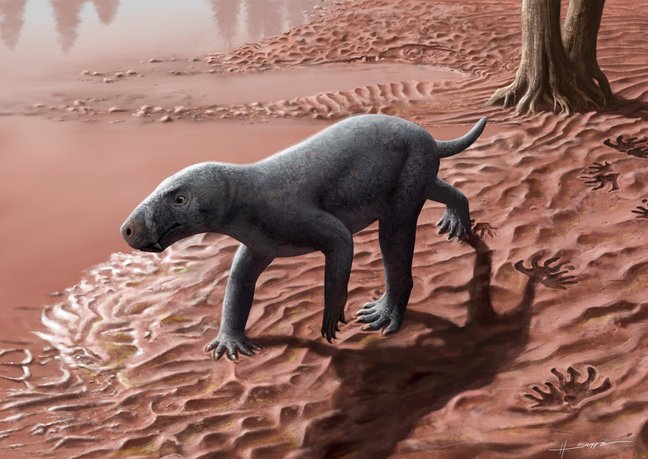
Gorgonopsians are sabre-toothed predators and belonged to the group of therapsids, from which mammals later evolved.
Little is known about the local and temporal origin of therapsids, although this group was an important part of the ecosystems in the Permian period. A recent discovery of several fossil bones of a gorgonopsian in Mallorca has contributed significantly to a better understanding of the origin of therapsids. It is the worldwide oldest gorgonopsian found to date, if not the oldest known therapsid. It enabled the research team, with the participation by Dr Eudald Mujal from the Natural History Museum in Stuttgart, to gather new insights into the early evolution of this group.
In a recent study, researchers led by Dr. Eudald Mujal have now described fossil footprints on Mallorca, also known as ichnites. The footprints were discovered near the previously found gorgonopsian.
Through analysis, these approximately 280-270 million-year-old footprints were exceptionally attributed to the very same species of gorgonopsid.
By examining the footprints, new knowledge can be gained about the gait of the gorgonopsid and its development of locomotion. For example, the footprints indicate an upright posture. The gait was also more similar to that of a mammal than a reptile. There was, if at all, hardly any lateral bending of the torso. The tracks therefore show that the upright leg posture of mammals already developed in the Lower Permian.
Such insights into the locomotion of these animals also contribute significantly to our understanding of the development of the typical mammalian mode of locomotion, which represents an important step in their evolution. This upright posture allowed for a more efficient mode of locomotion, which enabled the animals to quickly conquer more habitats.
Furthermore, it is likely that therapsids already exhibited a wide range of modes of locomotion in their early development.