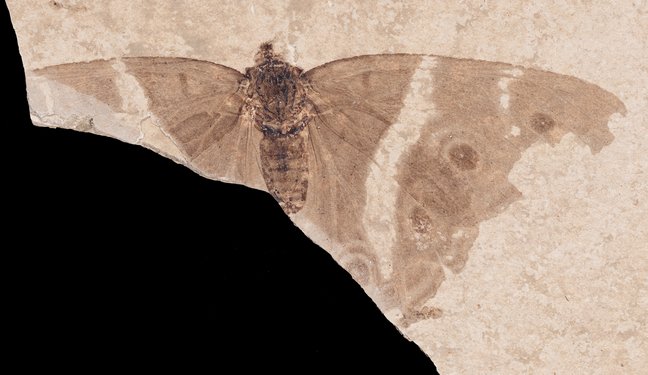
Butterfly fossils are rare, and finds that preserve fine anatomical details and wing patterns are an absolute exception. An international research team from Sweden, the USA, and Germany, led by Dr. Hossein Rajaei, lepidopterist at the State Museum of Natural History Stuttgart, and with the participation of Prof. Dr. Torsten Wappler from the Hessian State Museum Darmstadt, has now described an exceptionally well-preserved butterfly fossil, approximately 34 to 28 million years old. The specimen was discovered in the early Oligocene deposits of Céreste in southern France. The specimen, which belongs to a new genus and the newly described species Apaturoides monikae, is a key find for butterfly evolutionary research. It is also the first fossil that can be clearly assigned to the subfamily Apaturinae (in the family of brush-footedbutterflies). The results of the study were published in the journal Acta Palaeontologica Polonica.
A special insight into early butterfly evolution
Butterflies are among the best-studied insects today, but their fossil record is incomplete. Many previously reported ‘butterfly fossils’ cannot be clearly classified, and well-preserved finds that could serve as anchor points for evolutionary timelines are extremely rare.
"In the fossil of Apaturoides monikae from Céreste, most of the right wing and large parts of the left wing are preserved with complete wing venation and clearly recognizable wing patterns, including eye spots. The head and thorax are visible from both sides, and a large part of the abdomen has also been preserved. These exceptional features allow for precise classification in the butterfly family tree", explains Hossein Rajaei, lead author of the study.
A key find for researchers
Molecular genetic studies assume that the main lines of the emperor moth split at the same time as this fossil originated. Since the specimen described here is dated and reliably identified, it provides an important minimum age anchor point for evolutionary analyses and helps to reconcile fossil evidence with molecular ‘clock’ estimates.
“This fossil find suggests that the Apatura lineage is either older than molecular analyses suggest, or that today's Apatura species have preserved characteristics of their ancestors over long periods of time. In any case, the find provides an important empirical basis for better understanding when and how the most important butterfly groups evolved and diversified”, said Hossein Rajaei.
New genus and species: Apaturoides monikae
A detailed comparison with all known genera of Apaturinae shows that the fossil represents an extinct lineage most closely related to the genus Apatura, which is widespread in the Palearctic today. The new genus name Apaturoides reflects this relationship. The fossil was recovered in 1979 by Herbert Lutz from the laminated, freshwater-forming limestones of the Campagne-Calavon Formation. This site in the Lubéron region is now protected. The species name monikae honours Monika Lutz-Scholz, the discoverer's wife.
From fossils to current questions of biodiversity
The deposits of Céreste (Alpes-de-Haute-Provence) in southern France are known for their wide range of preserved organisms, but butterfly fossils remain a rarity even there. “This discovery highlights the importance of protected fossil deposits and the enduring value of museum collections and historical discoveries, which are often only recognized decades later and provide important scientific findings through new analyses”, said Torsten Wappler.
For editorial offices:
Original publication:
Rajaei, H., Wappler, T., De Jong, R., Wahlberg, N., & Engel, M.S. (2026). Exceptionally preserved Oligocene emperor butterfly from France provides a new calibration point for Apaturinae evolution. Acta Palaeontologica Polonica.
DOI: doi.org/10.4202/app.01332.2026
Erscheinungsdatum: 30.03.2026
Contact:
Dr Hossein Rajaei
State Museum of Natural History Stuttgart
Head of the Entomology Department
T: ++49/(0)711/8936/223
E: hossein.rajaei(at)smns-bw.de
Prof. Dr. Torsten Wappler
Hessisches Landesmuseum Darmstadt
Leiter der Abteilung Naturgeschichte
T: 49/(0)6151/3601/261
E: torsten.wappler(at)hlmd.de
Dr Hossein Rajaei and Prof. Dr. Torsten Wappler are available for questions and interviews.
Press contact:
Meike Rech
State Museum of Natural History Stuttgart
Press Officer
T: ++49/(0)711/8936/107
E: meike.rech(at)smns-bw.de
Or:
Tobias Wilhelm
T: ++49/(0)711/8936/104
E: tobias.wilhelm@smns-bw.de
Images:
Figure 1: Fossil and details of the new species Apaturoides monikae. A and B: dorsal view (part); C and D: ventral view (counterpart); A and D show the position of the fossil on the limestone with scale.
Copyright: Hossein Rajaei.
Figure 2: Fossil of the new species Apaturoides monikae.
Copyright: Hossein Rajaei.
Figure 3: Purple Emperor (Apatura iris (Linnaeus, 1758)). The new genus and species have been identified as close phylogenetic relatives of the today’s emperor butterfly.
Copyright: Peter Buchner.
The use of the image material is only permitted with the appropriate copyright notice and exclusively in the context of reporting on this press release. Thank you.
The State Museum of Natural History Stuttgart:
The State Museum of Natural History in Stuttgart is a forward-looking research and communication institution. As an archive of diversity, its research collection comprises over 12 million objects. The museum studies the evolution of life, analyses the biodiversity of various ecosystems and communicates research findings to the public (www.naturkundemuseum-bw.de).