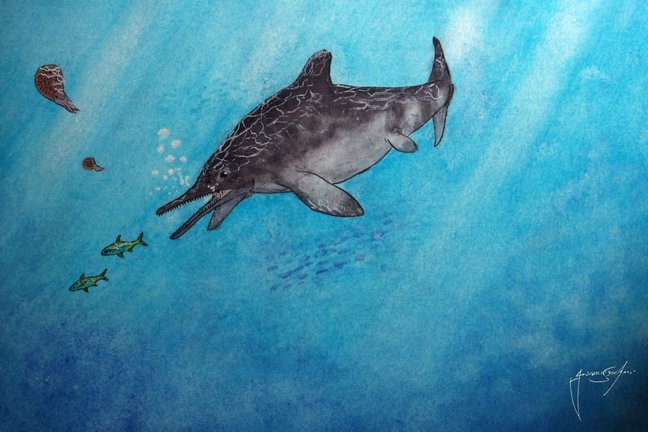
Ichthyosaurs are one of the most prominent groups of marine reptiles during the Mesozoic era existing from around 250 to 95 million years ago. Historically, the group was considered to have had its highest diversity during the Triassic period just shortly after its emergence and started to steadily decline afterwards. However, the last 20 years of research have shown that ichthyosaurs were still much more diverse during the following Jurassic and Cretaceous periods than previously believed.
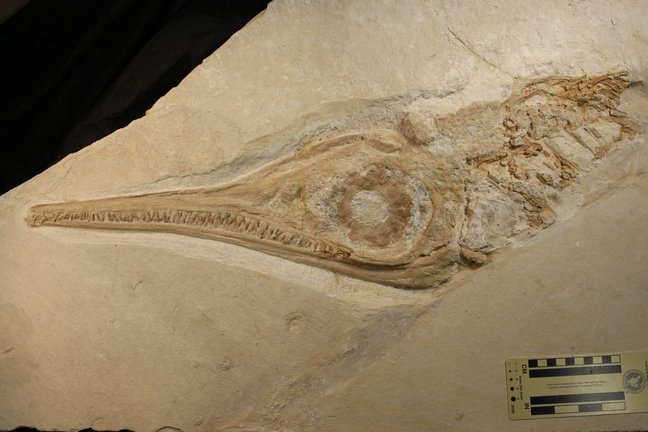
While the Early Jurassic Posidonia Shale of Southern Germany contains numerous species of ichthyosaurs, only a single species has been recorded from the Late Jurassic lithographic limestone of the same region. Both deposits are famous for their large number of mostly complete skeletons, which, in some cases, can even display preserved soft tissues and fossilized stomach contents. A new study by an international research team led by Dr. Erin Maxwell now features the description of a second species of ichthyosaur from the lithographic limestone, its results further challenging historical assumptions.
The new species Jabalisaurus tethyensis is described based on fossil specimens previously considered to belong to Aegirosaurus leptospondylus – the single known ichthyosaur from this region up until now. A close look at the skeletal anatomy of the known ichthyosaur material from the lithographic limestone found key differences between the two species. Additionally, the research team examined the soft tissue around the fins as well as the stomach contents of the new species in detail to learn more about its ecology.
The presence of this new species in Southern Germany has huge implications for the global distribution of ichthyosaurs during the Late Jurassic as a second species closely related to Jabalisaurus tethyensis is known from Mexico – a region previously interpreted as highly endemic in terms of its ichthyosaur fauna even though Europe and Central America were connected by sea and both regions shared subtropical climate conditions during the time. The new findings support the idea that faunal exchange must have taken place. Contemporaneous fossil localities from more temperate and boreal regions instead feature very different species of ichthyosaurs. Climate – directly or indirectly – may have been the main driver behind this global distribution pattern. Further research is necessary to reveal the true diversity of ichthyosaurs among superficially quite similar looking species.
The article was published in the scientific journal Palaeontologia Electronica.