
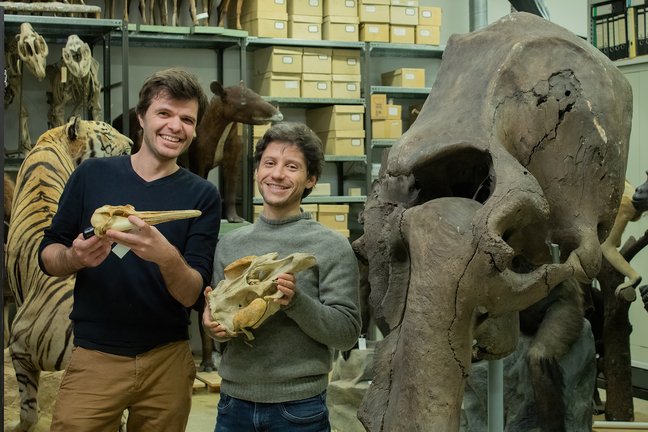
For many vertebrates – especially mammals – the sense of smell is absolutely essential for survival, as it often plays a key role in foraging, danger detection, or social interactions. To determine the acuity of the sense of smell in vertebrates, genetic studies can be used to examine the number of genes coding for olfactory receptors. The more active genes present for these receptors, the better the sense of smell. But how does one determine the olfactory performance of extinct species? Or species for which there is not yet enough genetic data? An international team led by Dr Quentin Martinez from the Stuttgart Museum of Natural History has now found a method to estimate the strength of a mammal’s sense of smell based on the morphology of its skull.
To determine whether the morphology of animal skulls provides clues about the development of the sense of smell, Dr Martinez’s team examined the shape and size of the braincases from animals across different mammalian groups. Using micro-CT scans of the skulls, the researchers created digital endocasts, which correspond to the shape of the brain. They specifically measured the size of the olfactory bulb, a part of the forebrain responsible for processing smells. In doing so, they discovered that it is not the absolute size of the olfactory bulb that provides information about the sense of smell, but rather its size in relation to the rest of the brain! The larger the olfactory bulb compared to other brain regions, the better the sense of smell.
Given its importance for survival, examining the sense of smell can provide important insights into the behaviour, ecology and evolution of vertebrates – even for species that are already extinct.
The research was published in the journal “Proceedings of the National Academy of Sciences”.