M.Sc. Marina Moser

Profilbild Marina Moser

Science Strategy and Development Officer

Entomology

Contact

Tel.:
+49 (0) 711 / 8936-2811
Fax:
+49 (0) 711 / 8936-100

Research Interests

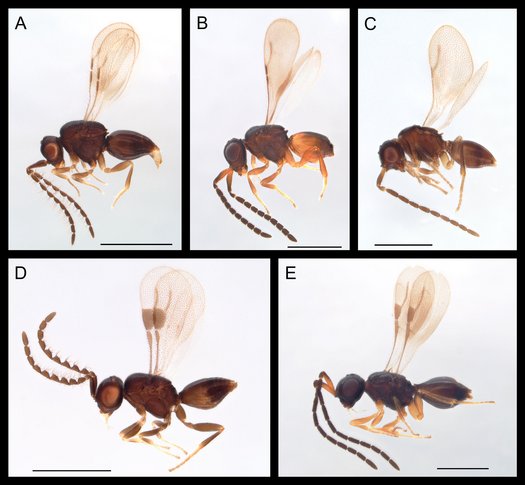
My research focuses on the superfamily Ceraphronoidea, tiny parasitoid wasps that, despite their global distribution and ecological importance, have remained largely unexplored. These insects play a crucial role in food webs as parasitoids and hyperparasitoids by regulating the populations of other insects and thereby contributing to the stability of ecosystems. Within the framework of the GBOL III: Dark Taxa project, I investigate their diversity in Germany, particularly in Baden-Württemberg. My research has shown that the actual species richness of this group is far greater than previously assumed: instead of the 35 species known so far, genetic analyses suggest at least 193 potential species in southwestern Germany alone.

My goal is to overcome existing challenges caused by the minute size and highly uniform appearance of these wasps. For example, I developed a new DNA barcoding protocol that, for the first time, enables a reliable success rate in the genetic analysis of these tiny insects. In addition to studying their genetic diversity, I also examine their ecological relationships and host associations, which remain completely unknown for more than 80% of the species. These findings help to better understand their role in complex food webs and reveal how intricately many species are interconnected.
Another key aspect of my work is the description of new species. In 2023, I identified and described the new species Aphanogmus kretschmanni and, using state-of-the-art micro-CT technology, created the first complete 3D cybertype – a digital reference model that makes this species accessible to researchers worldwide.

My research demonstrates that even in seemingly well-studied regions such as Germany, numerous undiscovered species still exist. Ultimately, through my work, I aim to promote the inclusion of so-called Dark Taxa, difficult-to-study and previously neglected insect groups, in biodiversity research and conservation. Only by understanding and naming these “invisible” species can we truly preserve the richness of life on Earth.

Projects

Publications

2025

  • Moser, M., Vasilița, C., Haas-Renninger, M., Pirvu, E., Haas, M., Krogmann, L. (2025) German Barcode of Life reveals unexpected diversity of Ceraphronoidea (Hymenoptera). Biodiversity Data Journal 13: e159561. https://doi.org/10.3897/BDJ.13.e159561
     
  • Moser, M., Krogmann, L. Wanke, D. (2025). Some insects are more equal than others: A comparison of popular large language model chatbots' treatment of different insect groups. Integrative Conservation, 4, 254-267. https://doi.org/10.1002/inc3.70013

2024

  • Moser, M., Salden, T., Mikó, I., & Krogmann, L. (2024). Synthesis of the host associations of Ceraphronoidea (Hymenoptera): a key to illuminating a dark taxon. Insect Systematics and Diversity, 8(6), 1-12. https://doi.org/10.1093/isd/ixae039

2023

  • Moser, M., Ulmer, J. M., van de Kamp, T., Vasilița, C., Renninger, M., Mikó, I., & Krogmann, L. (2023). Surprising morphological diversity in ceraphronid wasps revealed by a distinctive new species of Aphanogmus (Hymenoptera: Ceraphronoidea). European Journal of Taxonomy, 864(1), 146-166. https://doi.org/10.5852/ejt.2023.864.2095

  • Haas-Renninger, M., Schwabe, N.L.A., Moser, M., Krogmann, L. (2023) Black gold rush - Evaluating the efficiency of the Fractionator in separating Hymenoptera families in a meadow ecosystem over a two week period. Biodiversity Data Journal 11: e107051. https://doi.org/10.3897/BDJ.11.e107051

2022

  • Neumüller U, Burger H, Mayr AV, Hopfenmüller S, Krausch S, Herwig N, Burger R, Diestelhorst O, Emmerich K, Haider M, Kiefer M, Konicek J, Kornmilch JC, Moser M, Saure C, Schanowski A, Scheuchl E, Sing J, Wagner M, Witter J, Schwenninger HR, Ayasse M (2022) Artificial Nesting Hills Promote Wild Bees in Agricultural Landscapes. Insects, 13, 726. https://doi.org/10.3390/insects13080726
     
  • Vasilita C, Moser M, Krogmann L (2022) Mission possible: an optimised protocol for the unbarcodable Ceraphronoidea (Hymenoptera). Biodiversity Data Journal 10: e84860. https://doi.org/10.3897/BDJ.10.e84860
     
  • Haas M, Baur H, Schweizer T, Monje JC, Moser M, Bigalk S, Krogmann L (2021) Tiny wasps, huge diversity – A review of German Pteromalidae with new generic and species records (Hymenoptera: Chalcidoidea). Biodiversity Data Journal 9: e77092. https://doi.org/10.3897/BDJ.9.e77092

2021

  • Moser M, Burks RA, Ulmer JM, Heraty JM, van de Kamp T, Krogmann L. (2021) Taxonomic description and phylogenetic placement of two new species of Spalangiopelta (Hymenoptera: Pteromalidae: Ceinae) from Eocene Baltic amber. PeerJ 9:e10939 https://doi.org/10.7717/peerj.10939

2020

  • Awad J, Höcherl A, Hübner J, Jafari S, Moser M, Parsa M, Vogel J, Schmidt S, Krogmann L, Peters RS. 2020. Just launched! GBOL III: Dark Taxa, a large research initiative focusing on German and Central European parasitoid wasps (and lower Diptera). Hamuli 11(2).

CV

2022-2025

  • Research Manager in the Scientific Directorate

since 2020

  • PhD student,
    Department of Entomology, in cooperation with the University of Hohenheim, Institute of Biology, and the Center for Biodiversity and Integrative Taxonomy (KomBioTa).
    Titel of the PhD thesis: Illuminating a dark taxon: Exploring the German diversity of Ceraphronoidea (Hymenoptera) with an integrative taxonomic approach.

2017-2020

  • Master student (M.Sc.): Biology (University of Hohenheim)
    Master thesis: "Taxonomic description and phylogenetic placement of two new species of Spalangiopelta (Hymenoptera: Pteromalidae: Ceinae) from Eocene Baltic amber" in Fachgebiet Systematische Entomologie

2014-2017

  • Bachelor student (B.Sc.): Biology (University of Hohenheim)
    Bachelor thesis: "Connection between environmental events and wood anatomical anomalies in oak trees (Quercus petraea (Matt.) Liebl. and Quercus robur L.)" im Fachgebiet Archäo-/Paläobotanik

Membership in scientific societies

Awards

  • Studienpreis 2020 im Bereich Naturwissenschaften
    Studienpreis des Universitätsbund Hohenheim e.V. für die beste Master Thesis der Fakultät Naturwissenschaften 2020

  • Honorable Mention in the student presentation competition during the 2020 International Society of Hymenopterists (ISH) virtual symposium

Science Communication

  • Co-Curation of the special exhibition "Museum Spezial - Die Anderen Wespen [The Other Wasps]"
    June 2023 - November 2023 at Museum am Löwentor
    In cooperation with Leibniz-Institut für Wissensmedien (IWM) Tübingen