
Climate change is currently altering our environment faster than ever before. As a result, many animal and plant species now face new challenges. Whether they manage to cope and adapt depends largely on their genetic diversity. New genetic diversity is created only slowly. Species that already possess a broad range of genetic material today therefore have better chances of adapting to a rapidly changing environment.
An international team of researchers, including Dr. Niloofar Alaei Kakhki, an evolutionary biologist at the State Museum of Natural History Stuttgart, has published a new study showing the importance of genetic exchange between species. In many cases, reproduction—and thus genetic exchange—across species boundaries is not possible. However, closely related species often form exceptions and may produce fertile offspring (hybrids) that can, in turn, mate with individuals of their respective parent species.
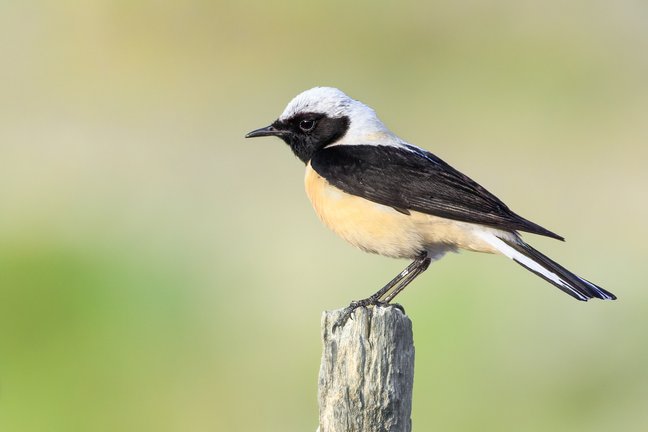
The study examined different species of wheatears, small songbirds with striking black-and-white plumage. By analyzing genes responsible for plumage color, the scientists discovered that closely related species were able to quickly adapt to new environmental conditions through the exchange of genetic material.
In the Eastern black-eared wheatear (Oenanthe melanoleuca), changes in a single colour gene led to the development of white plumage on the throat and back. Through hybridisation these genetic traits were passed to the closely related Western black-eared wheatear (Oenanthe hispanica). In both species, the white back coloration eventually replaced the original black. Today, individuals with either black or white throat colouration exist in both species—a phenomenon known as polymorphism. The researchers suspect that the occurrence of these colours is related to the birds' preferred food sources.
While newly developed genetic material is usually responsible for the long-term evolution of plumage coloration in distantly related species, the study shows that closely related species utilize the entire available genetic diversity—both within and between species—to adapt to their environment.
According to the authors of the study, it is therefore especially crucial in times of climate change to protect genetic diversity as effectively as possible.
The research was led by the Schweizerische Vogelwarte and the article was published in the renowned scientific journal 'Science'.