How do I create a herbarium?
07.05.2026 | Dipl.-Biol. Anette RosenbauerHave you always wanted to create your own plant collection? Here you’ll find tips and tricks from the experts for making your own herbarium.

Herbarium specimen of a purple morning glory. (Copyright: C. Dalitz / SMNS)
Herbarium – an up-to-date, centuries-old technique
For over 450 years, plants have been preserved for scientific purposes through pressing and drying.
Despite advances in technology, this simple technique remains in use even today, because it conserves plants in a way that still enables us to observe the features necessary for identifying them. What’s more, the specimens are suitable for genetic data analysis, even when dried. If stored in a dry, dark, cool and insect-proof environment, plants can appear as though they were freshly pressed, even after centuries.
The Stuttgart Herbarium houses over 800,000 pressed and dried vascular plants from all over the world. The oldest specimens originate from Siberia and were collected around 1740 by Alexander Wilhelm Martini.
It is not difficult to create your own herbarium. Here, we will share a few tricks to ensure your success.
Herbarbeleg einer Purpur-Prunkwinde. Einzelne Blätter, Stängel und violette Blüten liegen auf einem weißen Blatt Papier. Ebenfalls auf dem Blatt Papier ist ein kleiner Zettel mit den Funddaten der Pflanze.
Even after nearly 300 years, the pressed purple morning glories still look almost fresh. (Copyright: C. Dalitz / SMNS)
Why should you create a herbarium?
Having your own herbarium is the best way to really get to know different plant species. When identifying, collecting, placing, labelling, and mounting plants, you engage closely with their characteristics. The details are particularly easy to observe in the pressed plant on a white sheet of paper, making it much easier to remember them all together. Pressed plants are also an excellent point of reference for further plant identification, as significantly more details can be observed on them than in photos or illustrations found in identification guides.
One possible aim for your own herbarium could be to document all the plant species of a particular area.
Zwei Frauen stehen im Schatten eines Baumes vor einer grünen und sonnigen Wiese. Anette Rosenbauer (links) hält ein großes, weißes Blatt Papier mit einer darauf befestigten, gepressten Pflanze. Christiane Dalitz (rechts) hält eine kleine Lupe und eine Pflanze mit weißen Blüten.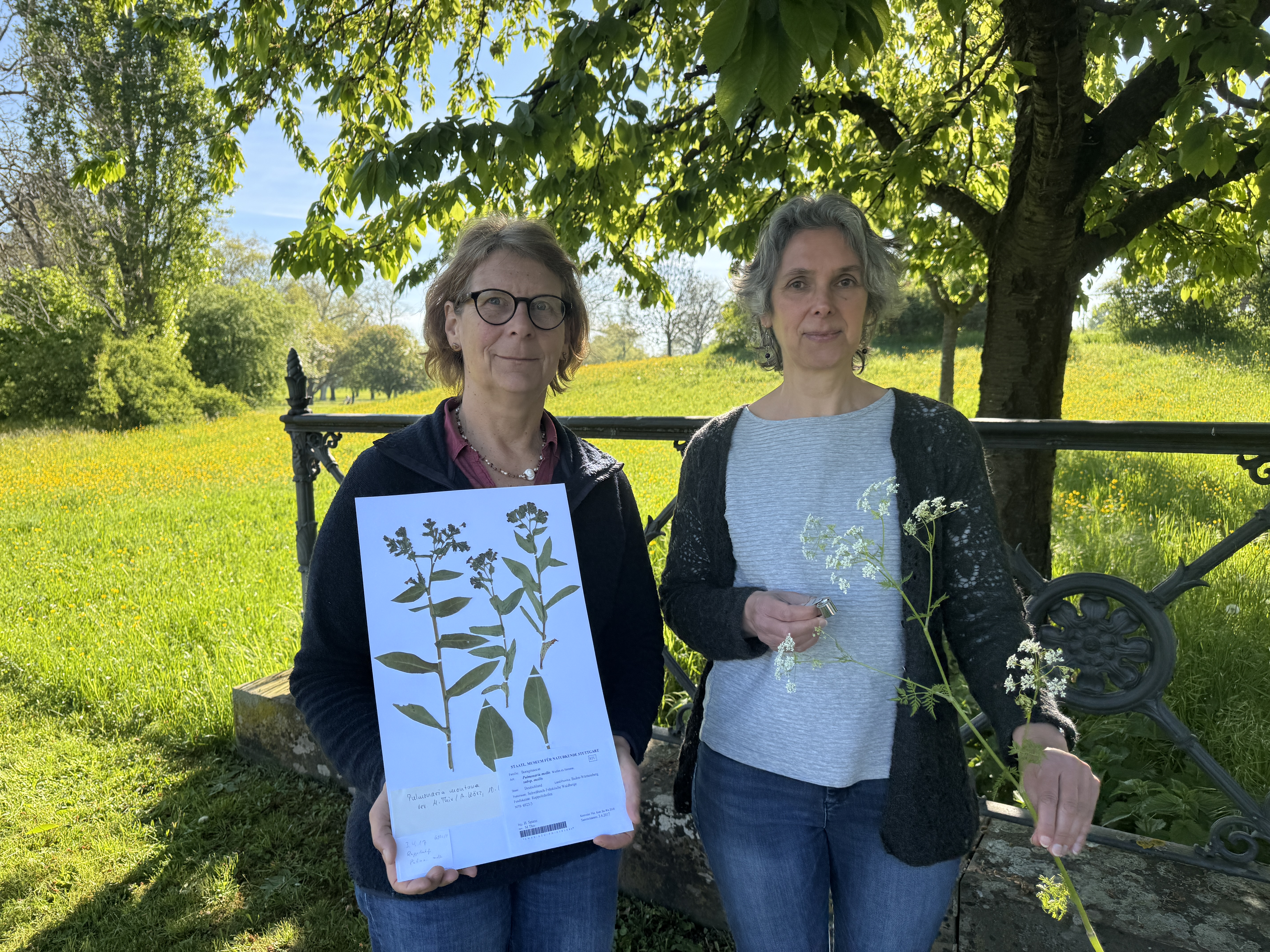
Dipl.-Biol. Anette Rosenbauer and Dipl.-Biol. Christiane Dalitz, Department of Botany, SMNS. (Bild: Y. Scheurer / SMNS)
Selecting and collecting plants
Of course, the first step is selecting the plant or parts of the plant:
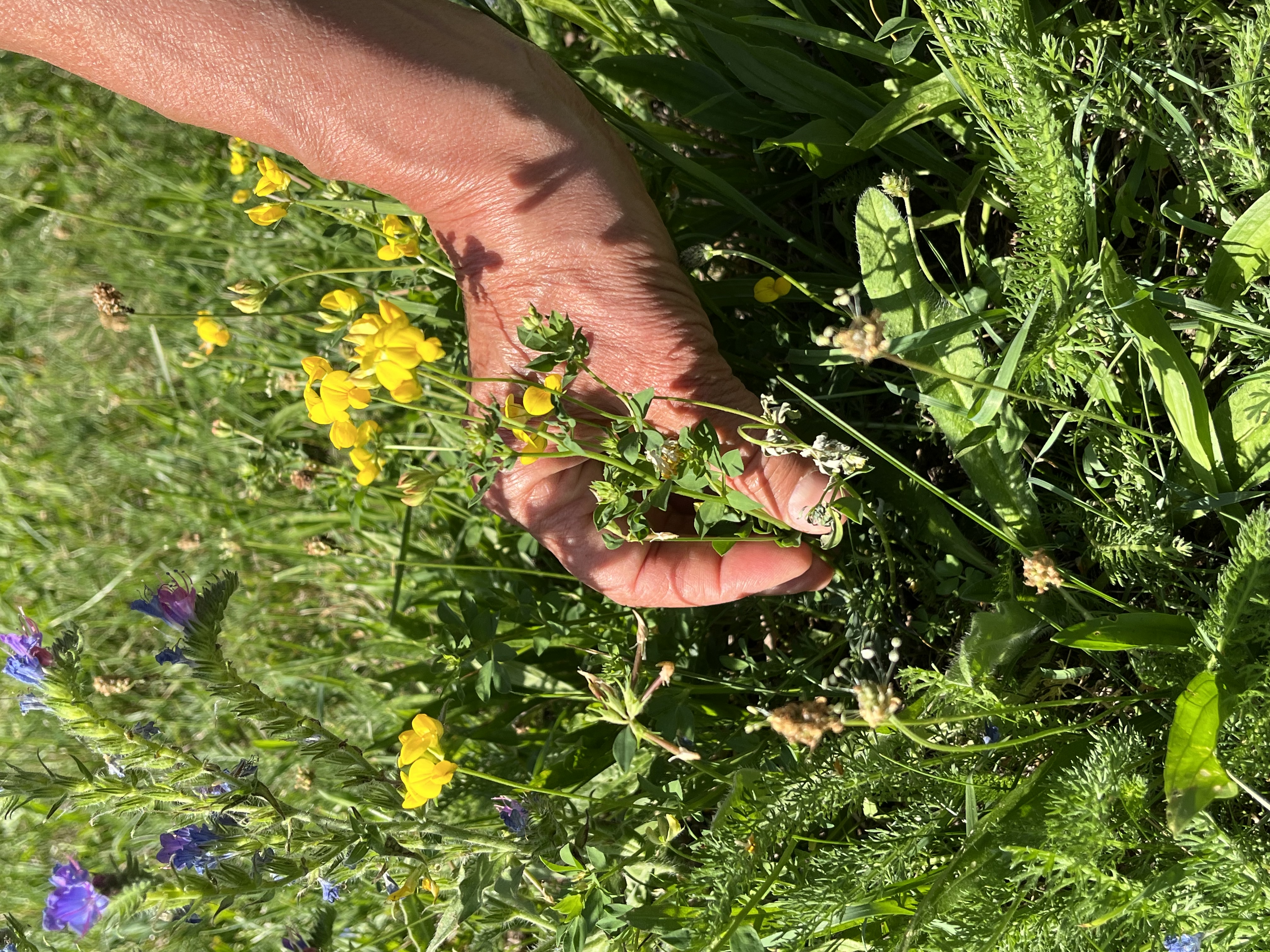
All parts necessary for identifying the species should be included. For small species, you can press the entire plant. For larger species or woody plants, you should select representative parts, such as flowers, fruits, leaves, or twigs. As a general rule, when collecting, you should bear the following in mind:
- Collect plants as completely as possible: basal leaves, stem, flower, fruits, and roots.
Only then can they be reliably identified. - Collect typical, well-developed specimens.
- Collect during dry weather, as this allows the plants to dry more quickly and helps to better retain their colours.
- Do not collect plants in protected areas, nor protected or rare species!
- Even when collecting unprotected species, make sure that your collecting does not endanger the population.
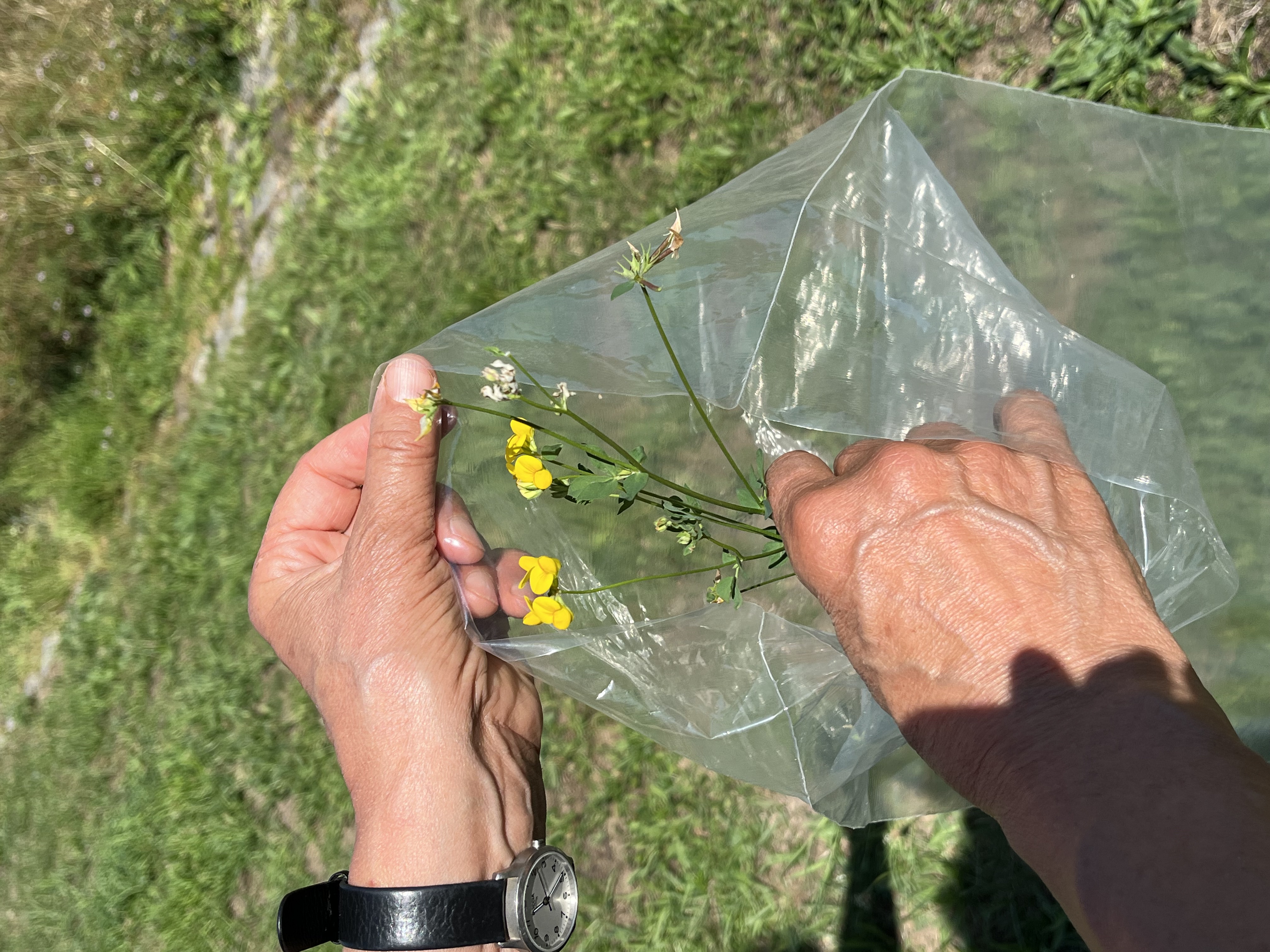
The collected plants should be transported in a sealed plastic bag and placed in a plant press as soon as possible.
Very delicate plants can be placed straight into folded newspaper on site, to prevent, for example, poppies or speedwell from losing their petals.
(Copyright: C. Dalitz / SMNS)
(Copyright: C. Dalitz / SMNS)
The plant press
Plant presses made of metal are durable, lightweight and practical, but quite expensive.
The commonly found square “flower presses” made from plywood are rather impractical: firstly, because of their shape, as plants are generally more elongated than square; and secondly, the screw fastenings are cumbersome.
You can easily make your own plant press from two newspaper-sized boards (5–10 mm thick) and two tension straps. It is filled with newspaper and suitably cut pieces of corrugated cardboard.
Eine Pflanzenpresse. Zwischen zwei rechteckigen Holzplatten ist ein Stapel gefalteter Zeitungen zu erkennen. Die Holzplatten und Zeitungen werden durch zwei Spanngurte zusammengehalten. Die obere Holzplatte hat viele kleine runde Löcher und ist mit einem grünen Pflanzenmuster verziehrt.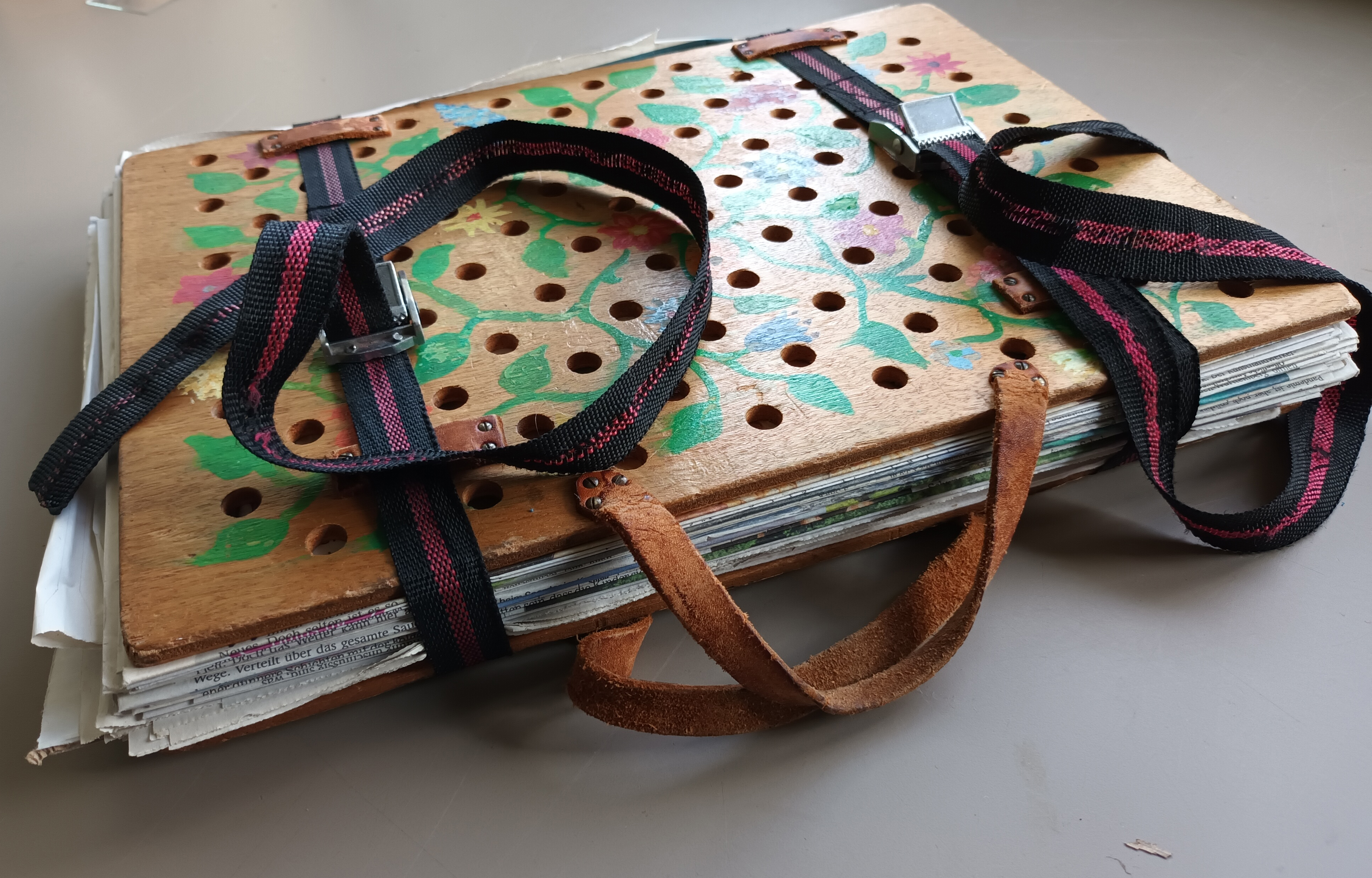
(Copyright: A. Rosenbauer / SMNS)
How to press plants
For pressing, the plant is spread out on a sheet of newspaper so that the leaves lie flat and do not overlap. Individual leaves are turned over or folded to reveal the underside. Large, flat flowers are arranged so that you can see into them. Flowers and flower heads can be partially cut open to show, for example, the stamens. Very thick flower heads or root tubers can be halved, with the cut halves placed next to each other.
In einen offenen Zeitungsblat liegt eine vollständige Wiesenblume mit Blüten, Stängeln, Blättern und Wurzeln. Neben der Pflanze ist ein grüner Klebezettel mit dem Namen und den Funddaten der Pflanze.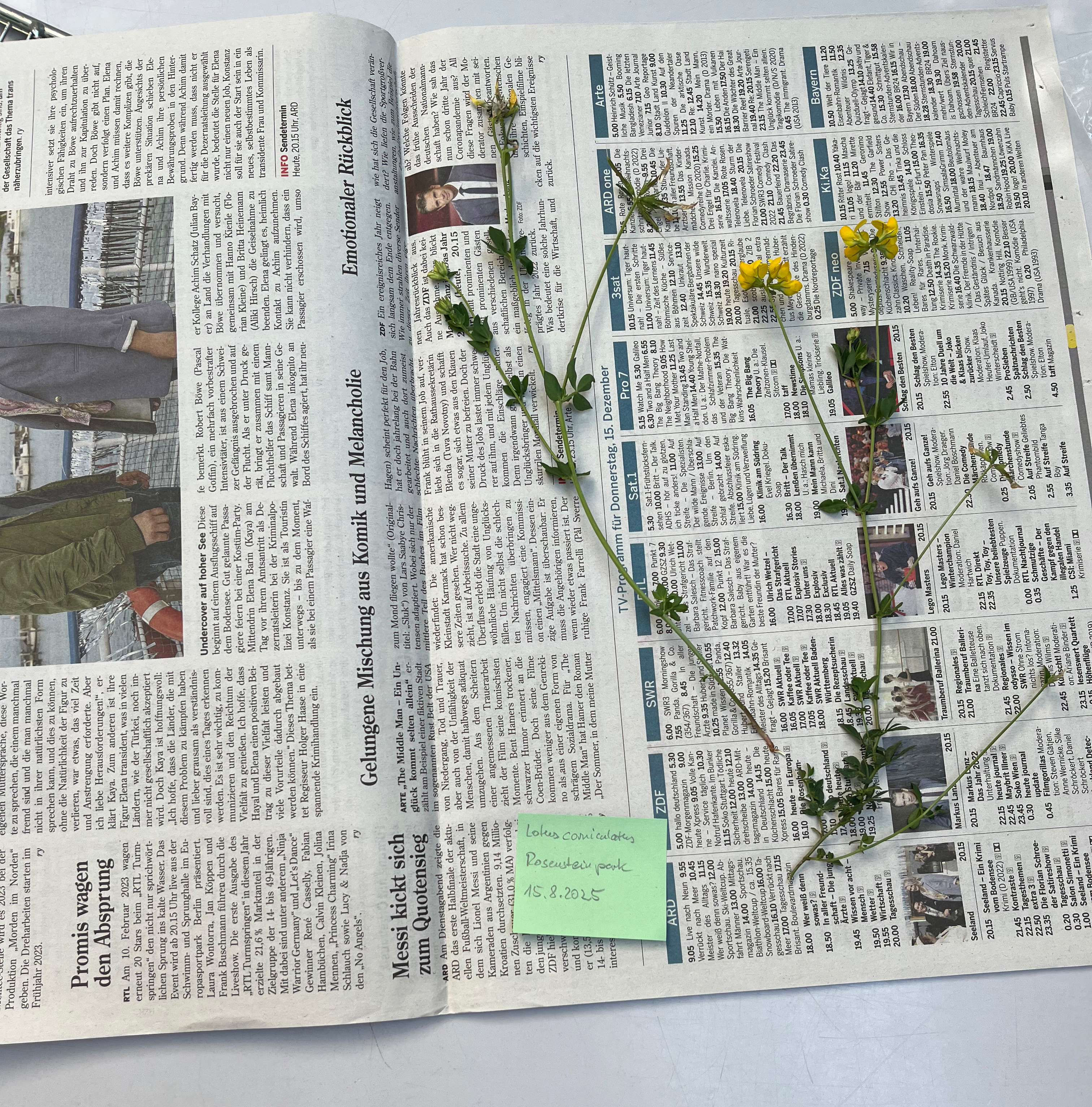
Important! A note with the name, location, and date should be included in the press right from the start. Thinking “I’ll remember when and what I collected” unfortunately rarely works. It’s a pity to find beautiful specimens in the plant press weeks or months later and no longer be able to recall when or where they were collected. (Copyright: C. Dalitz / SMNS)
In einen offenen Zeitungsblat liegt eine vollständiges Gras. Da das Gras zu groß für das Zeitungsblatt ist, wurde es zickzackartig geknickt. Neben der Pflanze ist ein grüner Klebezettel mit dem Namen und den Funddaten der Pflanze.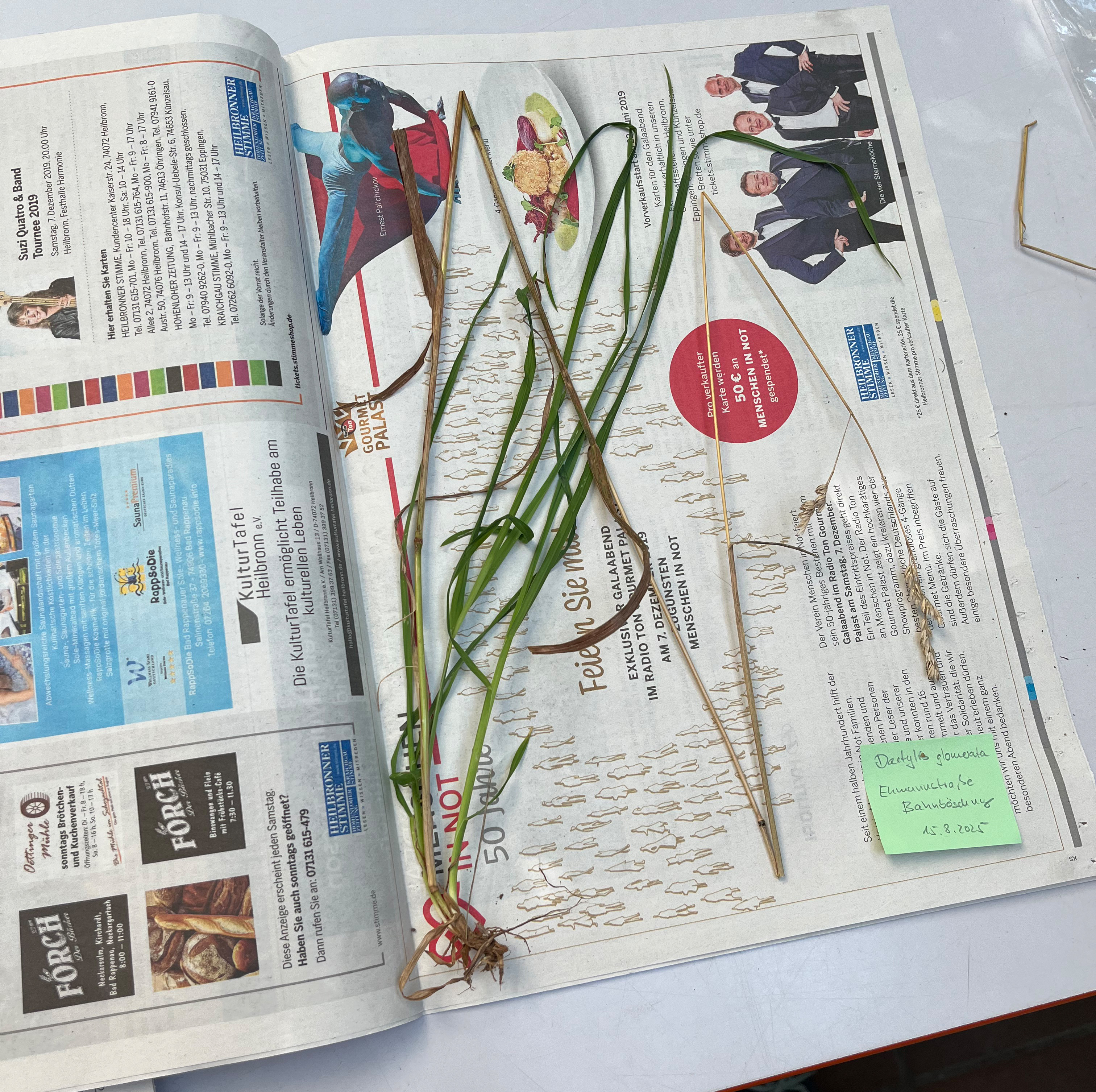
Now the newspaper is closed. The plant remains in this simple paper layer until it has completely dried. (Copyright: C. Dalitz / SMNS)
Eine Pflanze in einem Zeitungsblatt wird gerade in eine metallische Pflanzenpresse gelegt.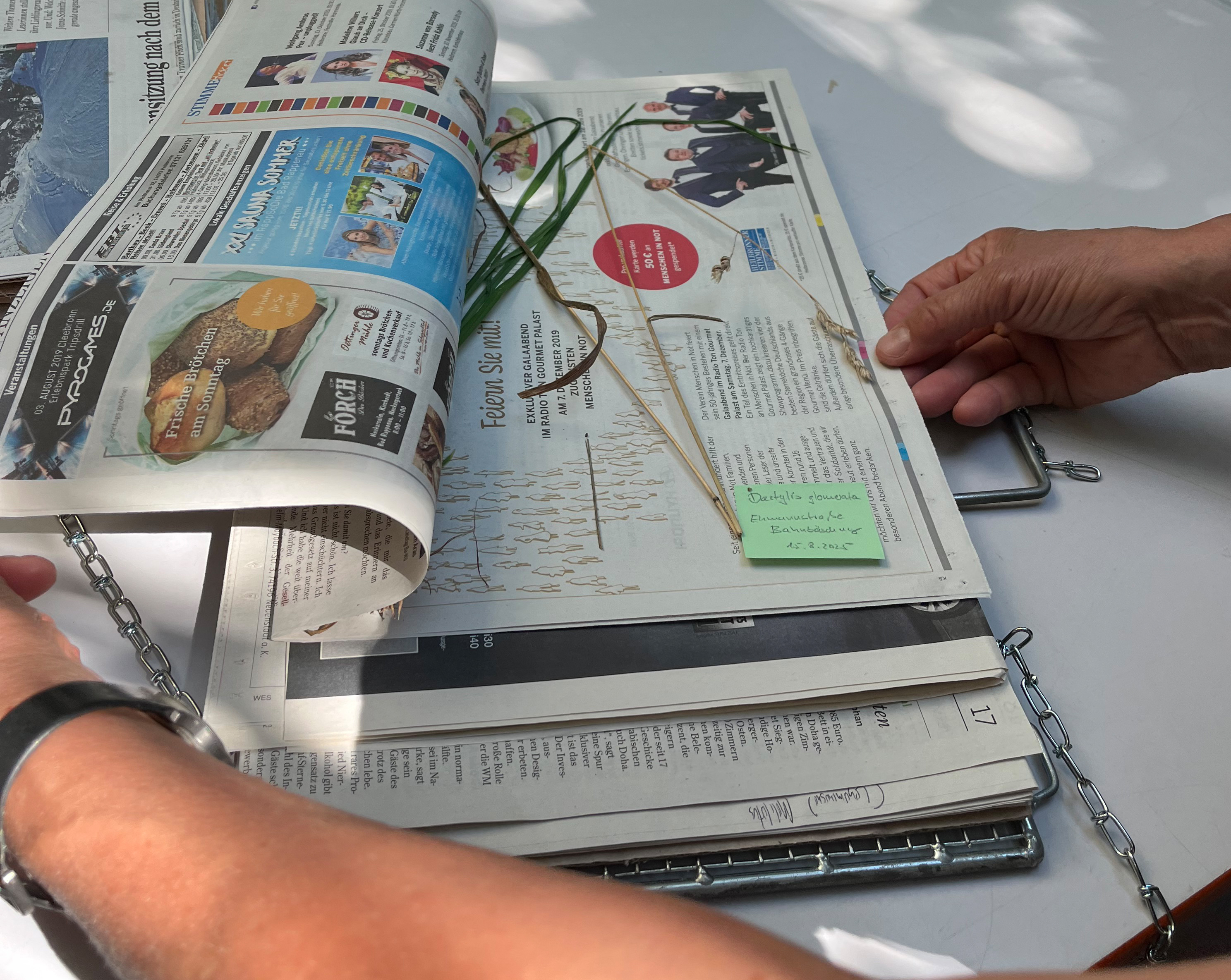
As an absorbent intermediate layer, place a thick stack of newspapers on top, then the next sheet for the next plant. If you place the folds of the newspapers containing the plant to the right, and those of the thick intermediate layers to the left, you can easily replace the damp absorbent layers. Insert a piece of corrugated cardboard every few layers; this provides good ventilation and evens out any irregularities. (Copyright: C. Dalitz / SMNS)
In eine Pflanzenpresse aus Metall werden zusätzliche Zeitungsblätter als saugfähige Schicht gelegt.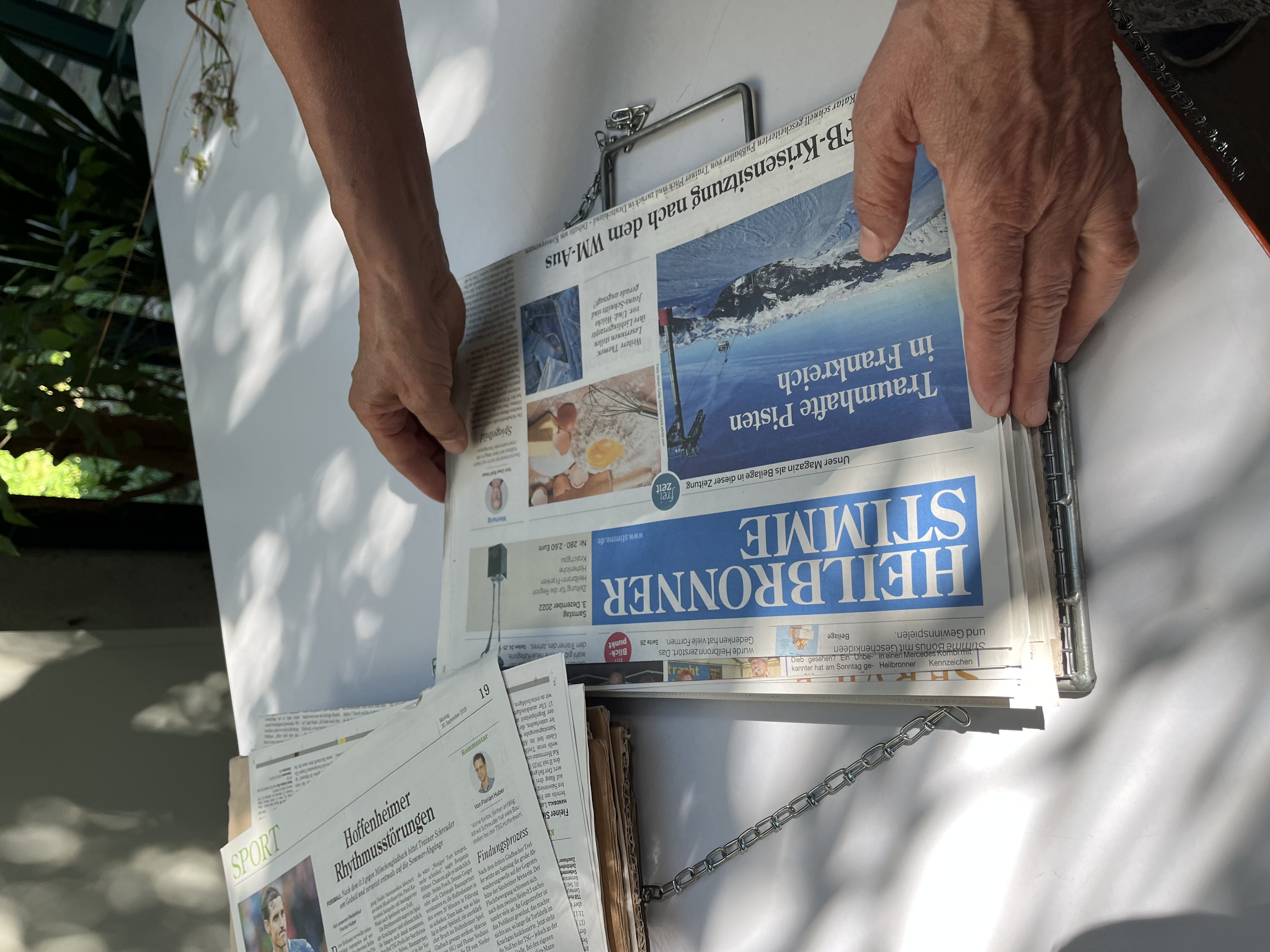
Once all the plants have been prepared, the entire stack goes into the press. The press is then pulled tightly together with the straps or chains. (Copyright: C. Dalitz / SMNS)
Eine Pflanzenpresse aus Metall wird geschlossen und mit Metallketten zugezogen.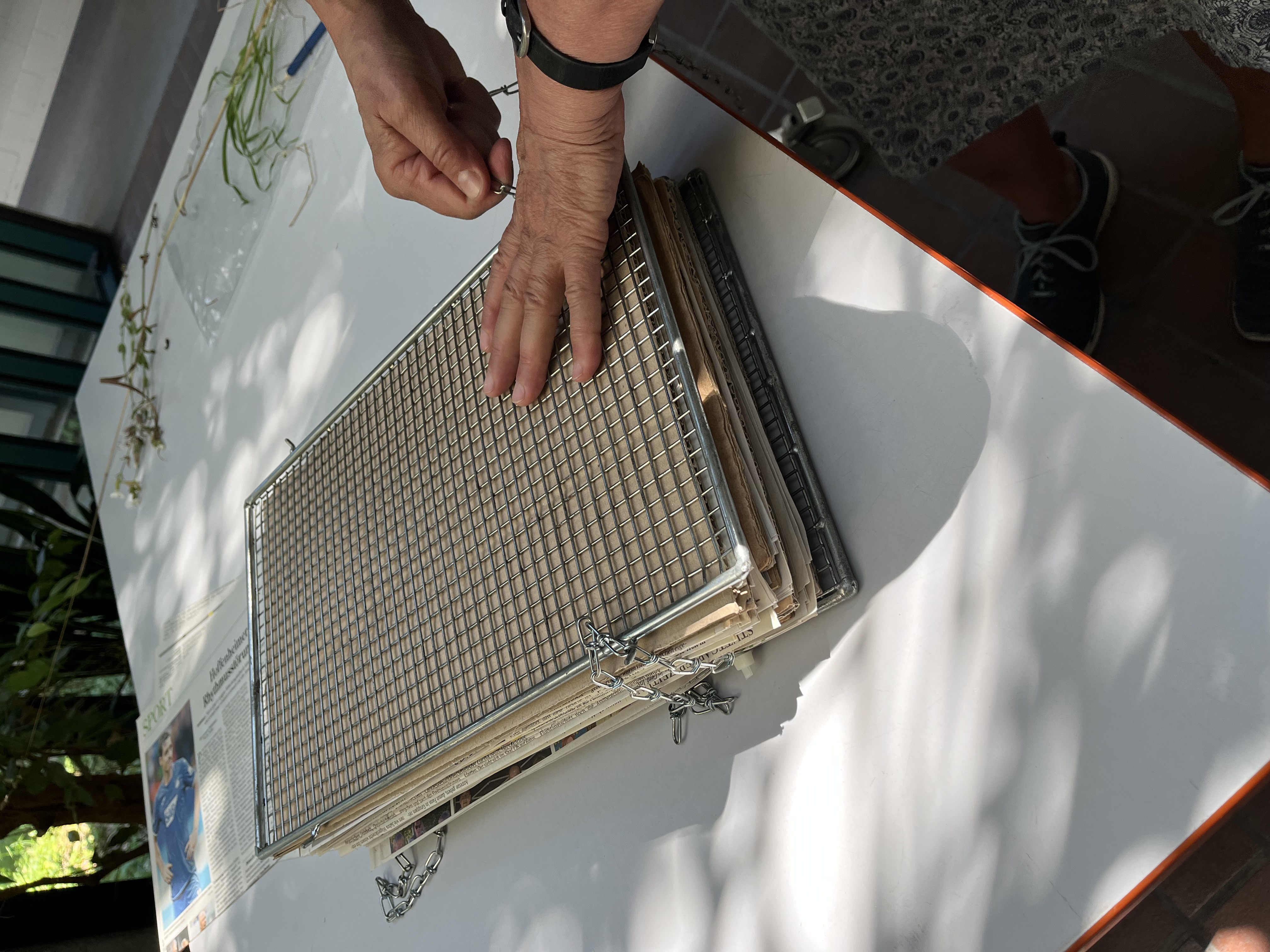
The faster the plants dry, the better their natural colours are preserved, as well as the DNA – which is particularly important for scientific research. For this reason, it is very important to replace the damp absorbent layers with dry newspaper several times during the first few days and to place the plant press somewhere warm and dry. (Copyright: C. Dalitz / SMNS)
Eine professionelle Pflanzenpresse. In einem schrankartigen Gerüst aus Metall liegt ein Gewicht auf einem Stapel Wellpappe. 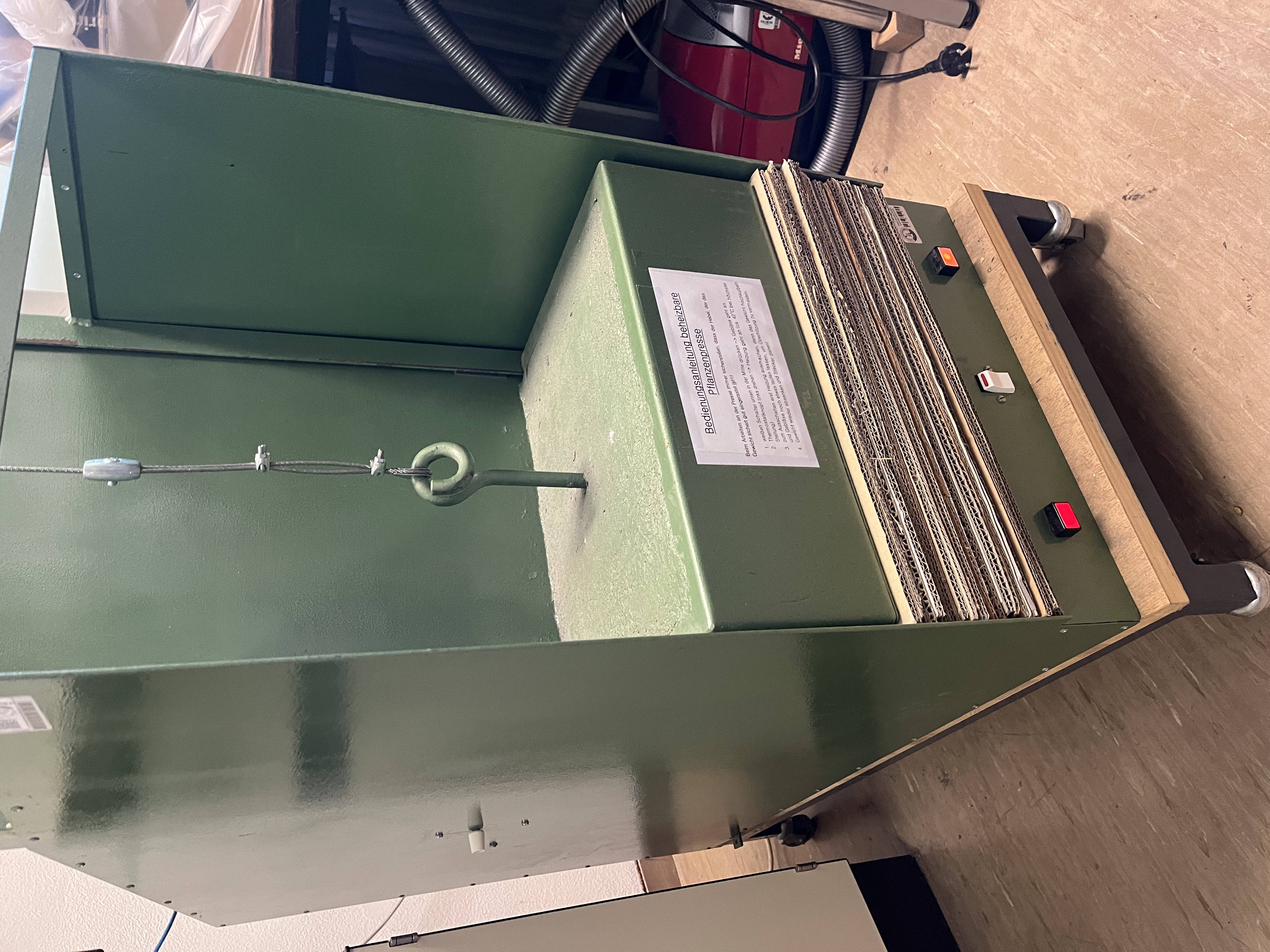
In our herbarium, we have a plant press that allows us to dry large quantities of plants quickly. A built-in warm air blower and a 20 kg concrete weight ensure perfect results. (Copyright: C. Dalitz / SMNS)
Indispensable: the label
A complete label is absolutely essential for every specimen. Without collection data, a dried plant may be pretty, but it is scientifically worthless. If you write the labels by hand, you should write clearly and use a lightfast pen (pencil or document-proof ballpoint pen); otherwise, it is best to print the label using a laser printer.
For scientific collections, the label must contain the following information:
- Herbarium owner
- Scientific plant name with author
- Plant family
- Location: country, region, district, province, canton, etc.
Even someone unfamiliar with the area should be able to find the collection site.
Example: Germany, Baden-Württemberg, Backnang-Steinbach, woodland edge at the northern edge of the village. - Habitat: e.g. open deciduous woodland, shady ditch, garden weed, etc.
If possible, also the geological substrate. - Coordinates and altitude above sea level
- Collection date with the full year, e.g. 15/08/2025 and not just 15/08/25
- Who collected the plant?: leg. (legit = collected by)
- Who identified the plant?: det. (determinavit = identified by) should be included, especially if this differs from the collector.
- Collection number: Anyone wishing to create a scientific herbarium should number their specimens consecutively.
Beispieletikett mit Funddaten einer Pflanze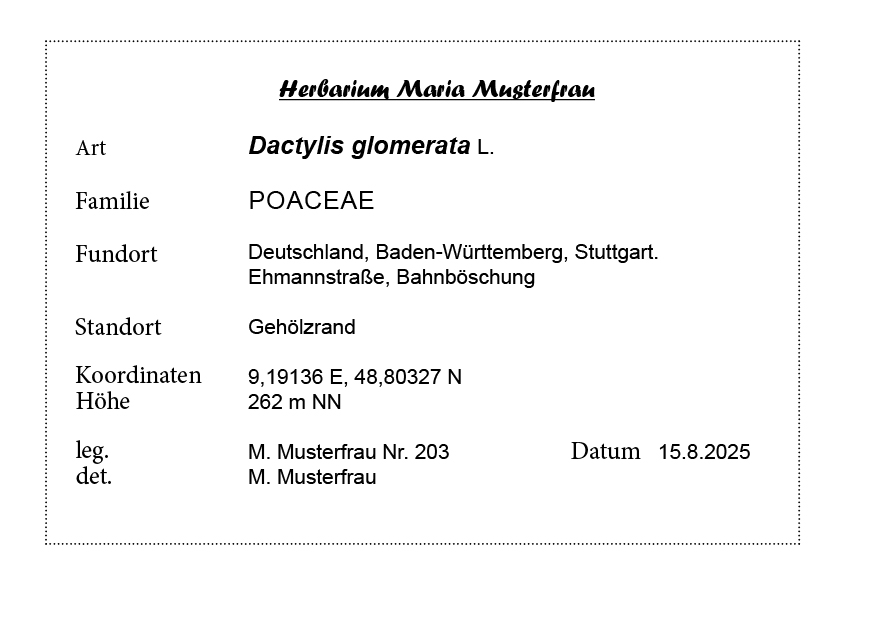
This is how it might look like.
Mounting the plants
The dried plants are mounted onto a stiff sheet of paper using narrow, gummed strips of paper.
Adhesive tape is unsuitable, as it discolours, damages both the paper and the plant, and quickly peels off.
It is important that the plant is firmly attached, so that no parts break off when the specimen is handled or rearranged, ensuring it is preserved for a long time.
When mounting, care should be taken not to cover any features important for identification.
Meterialien, die für das Fixiren von Pflanzen in einem Herbar benötigt werden: Schere, Pinzette, Klebstoff, gummierte Papierstreifen, Kissen zum befeuchten der gummierten Streifen. 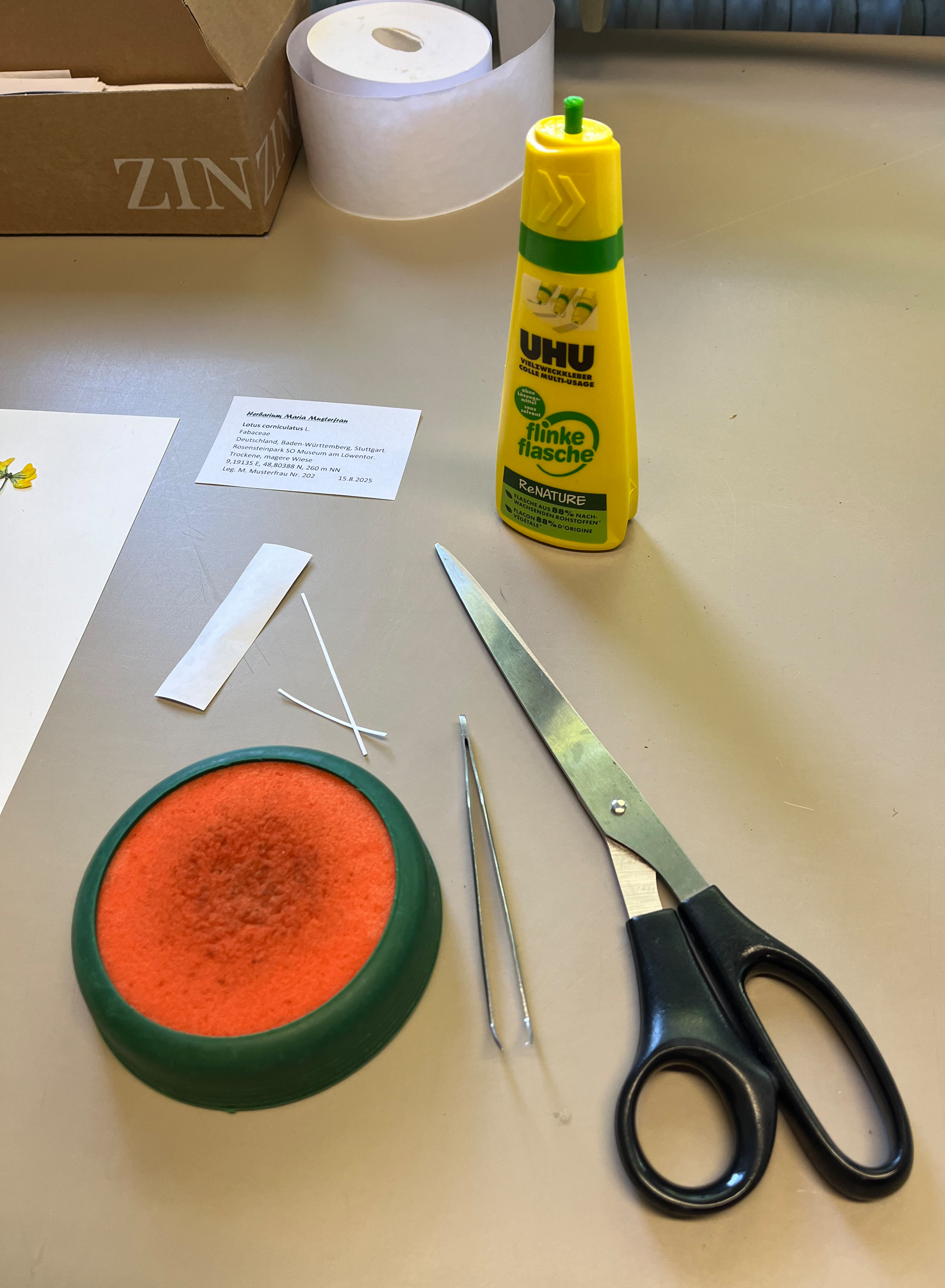
This is what you need. (Copyright: C. Dalitz / SMNS)
Eine Pflanze auf einem weißen Blatt Papier.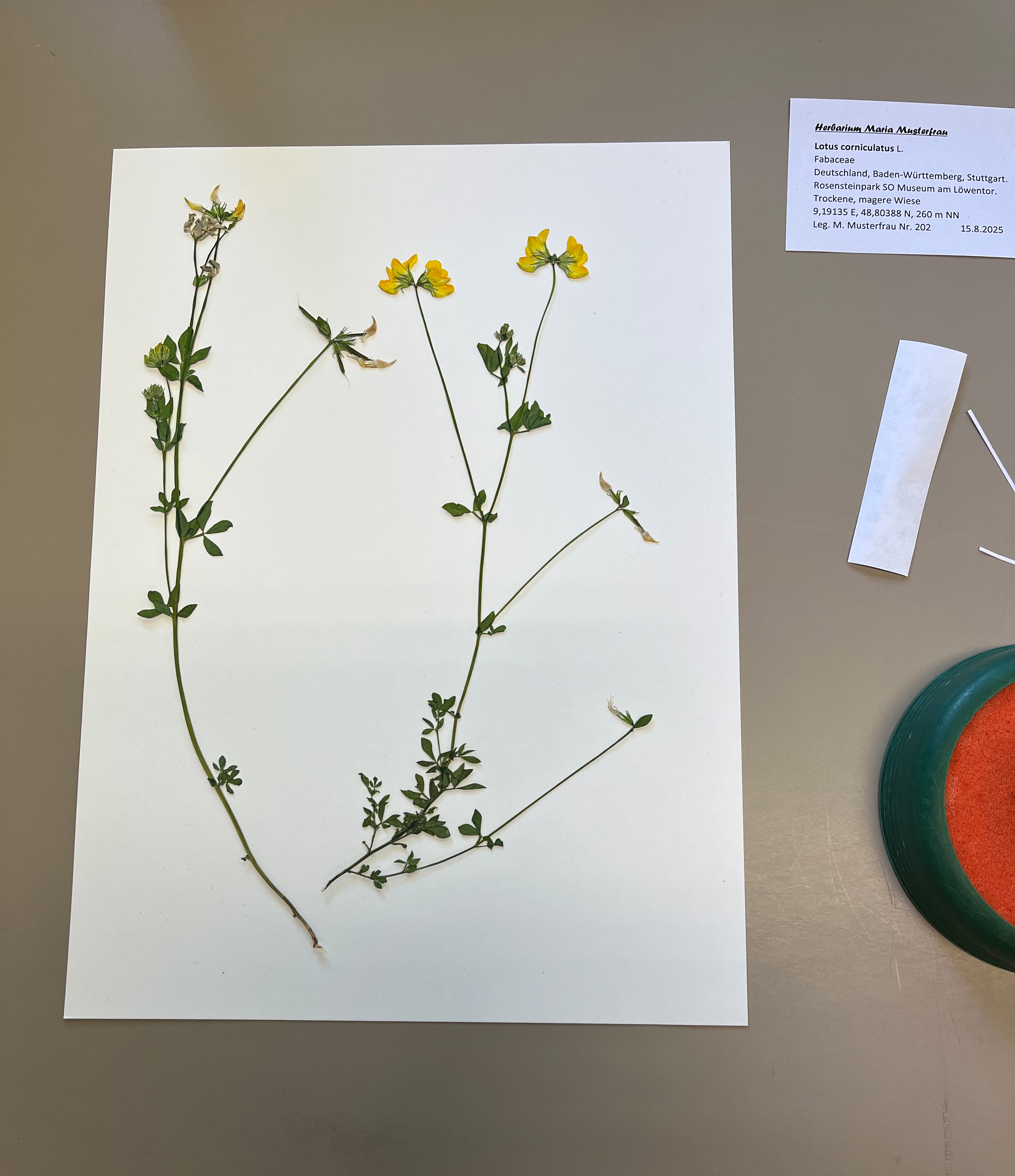
Before mounting, the plant is arranged on the herbarium sheet . (Copyright: C. Dalitz / SMNS)
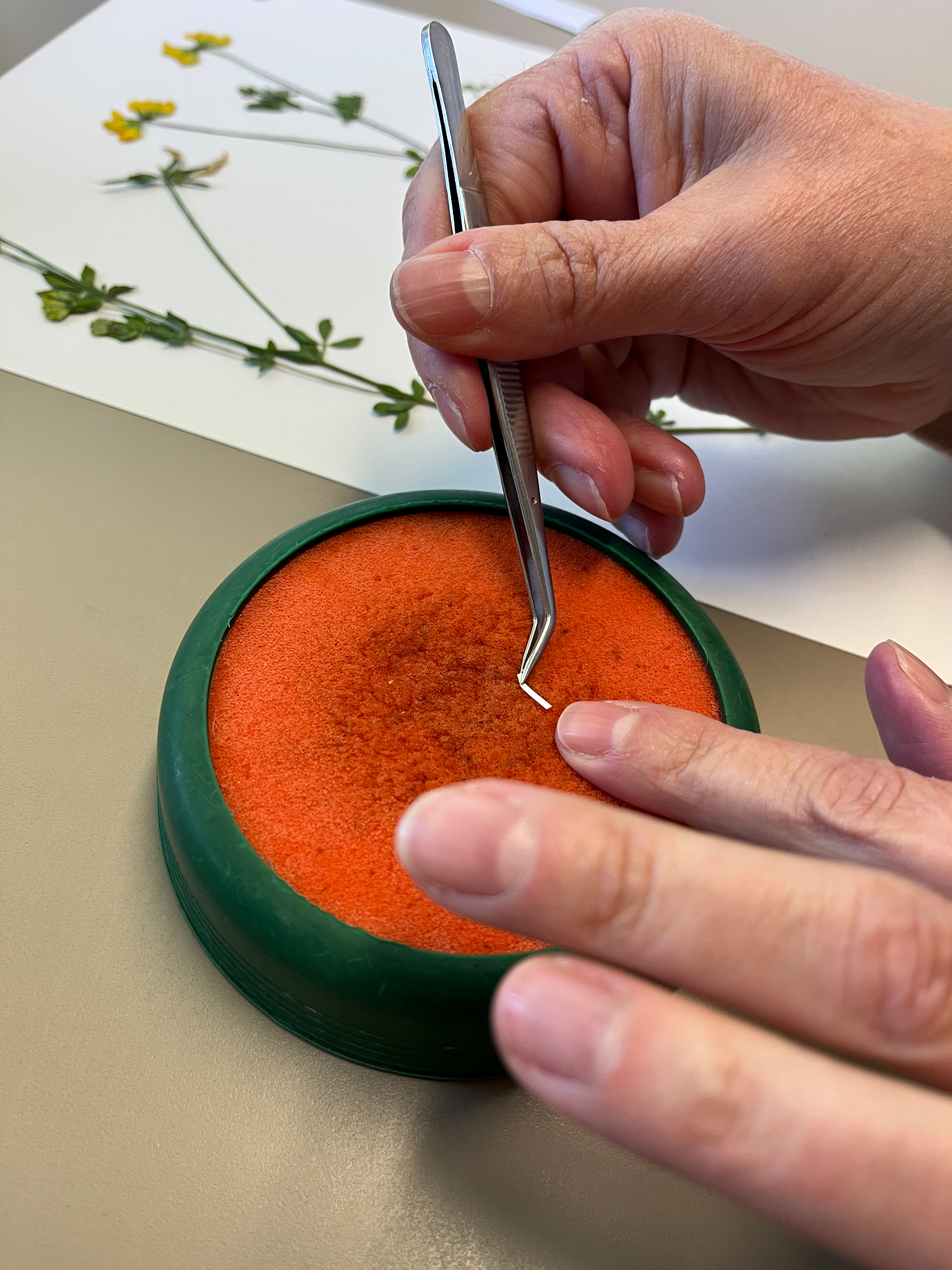
By moistening them, the gummed paper strips become sticky. (Copyright: C. Dalitz / SMNS)
mit Hilfe einer Pinzette wird eine Pflanze mit gummierten Papierstreifen auf einem weißen Blatt Papier fixiert.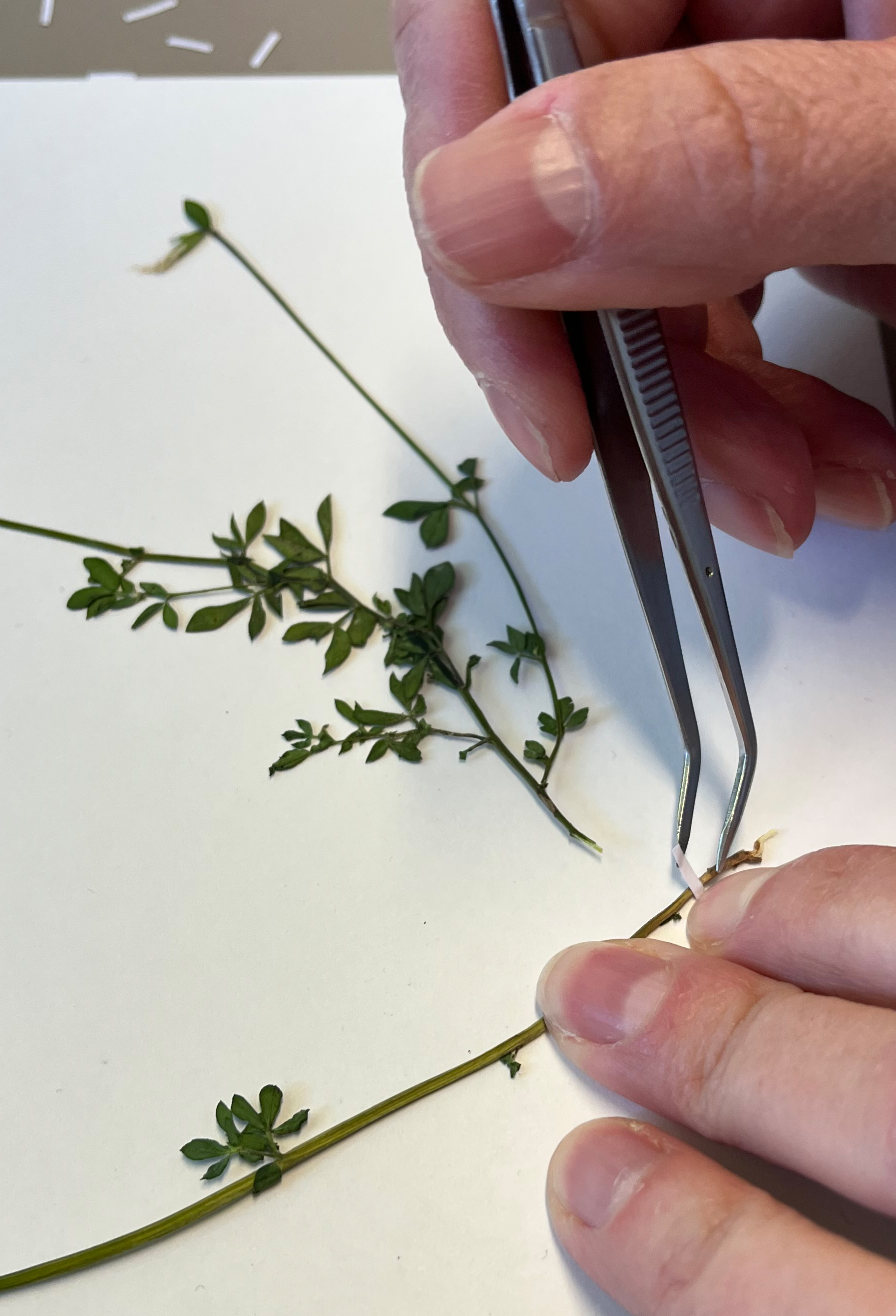
For secure mounting, the gummed strips should be fixed as close to the stem as possible. (Copyright: C. Dalitz / SMNS)
Auf einem weißen Blatt papier liegt eine Pflanze. Ein Etikett mit Funddaten wird mit Hilfe von flüssigem Klebstoff neben der Pflanze aufgeklebt.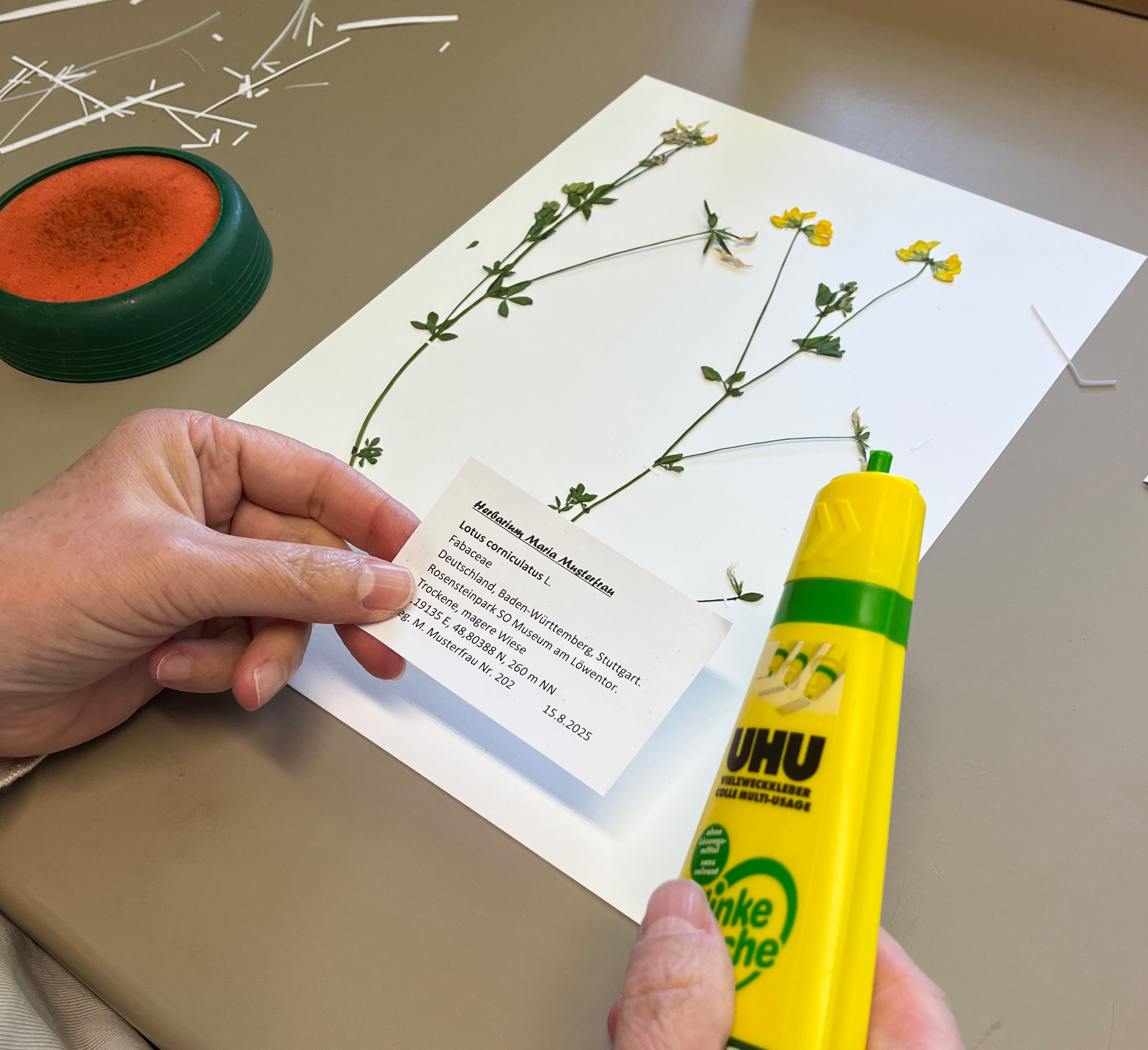
Solvent-free adhesive has proven effective for attaching the labels. (Copyright: C. Dalitz / SMNS)
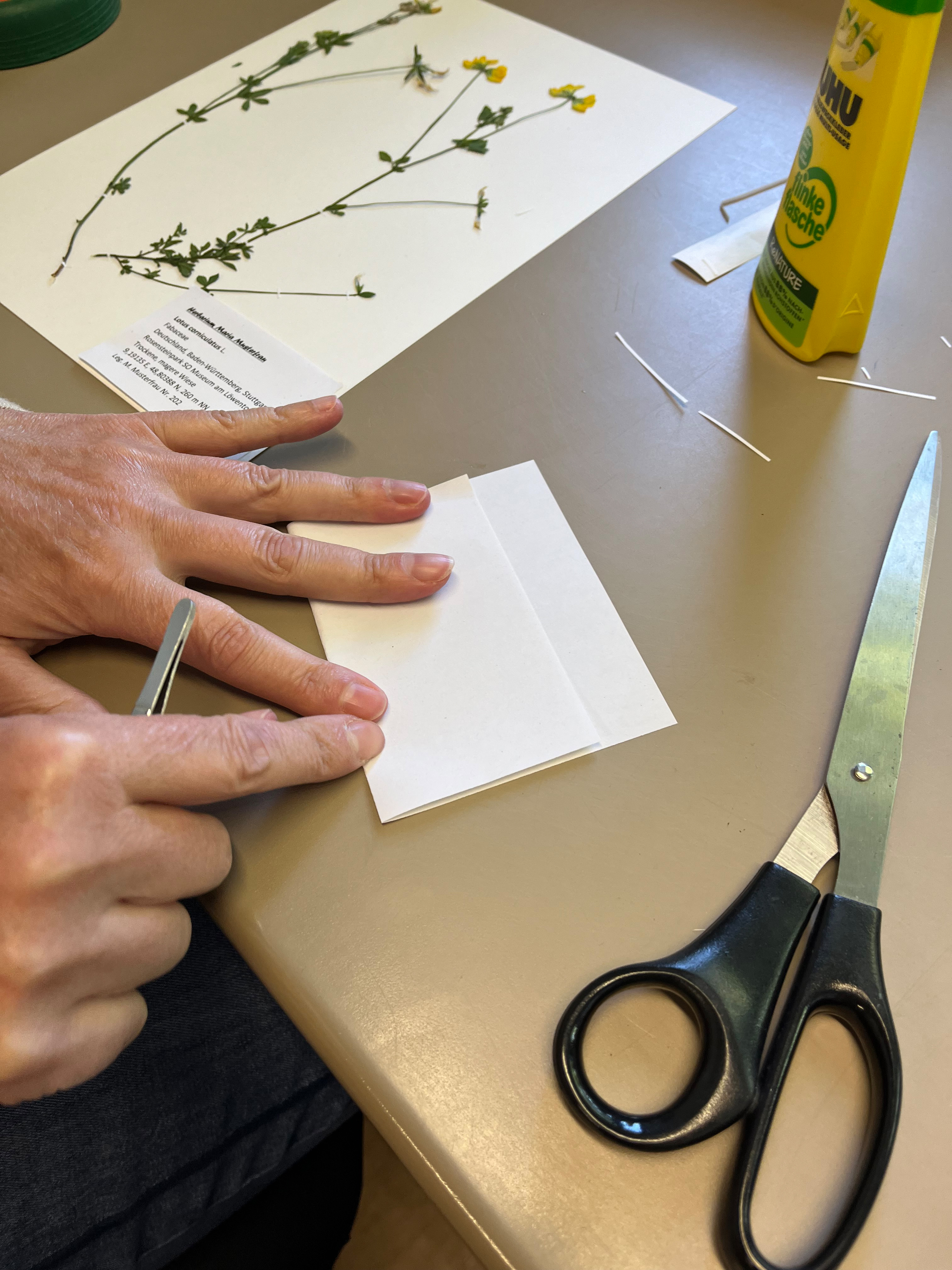
Small parts that have come loose during pressing (seeds, petals, etc.) are kept in so-called capsules. To make one, fold a postcard-sized piece of paper into an envelope, place the loose parts inside, and stick it onto the herbarium sheet. (Copyright: C. Dalitz / SMNS)
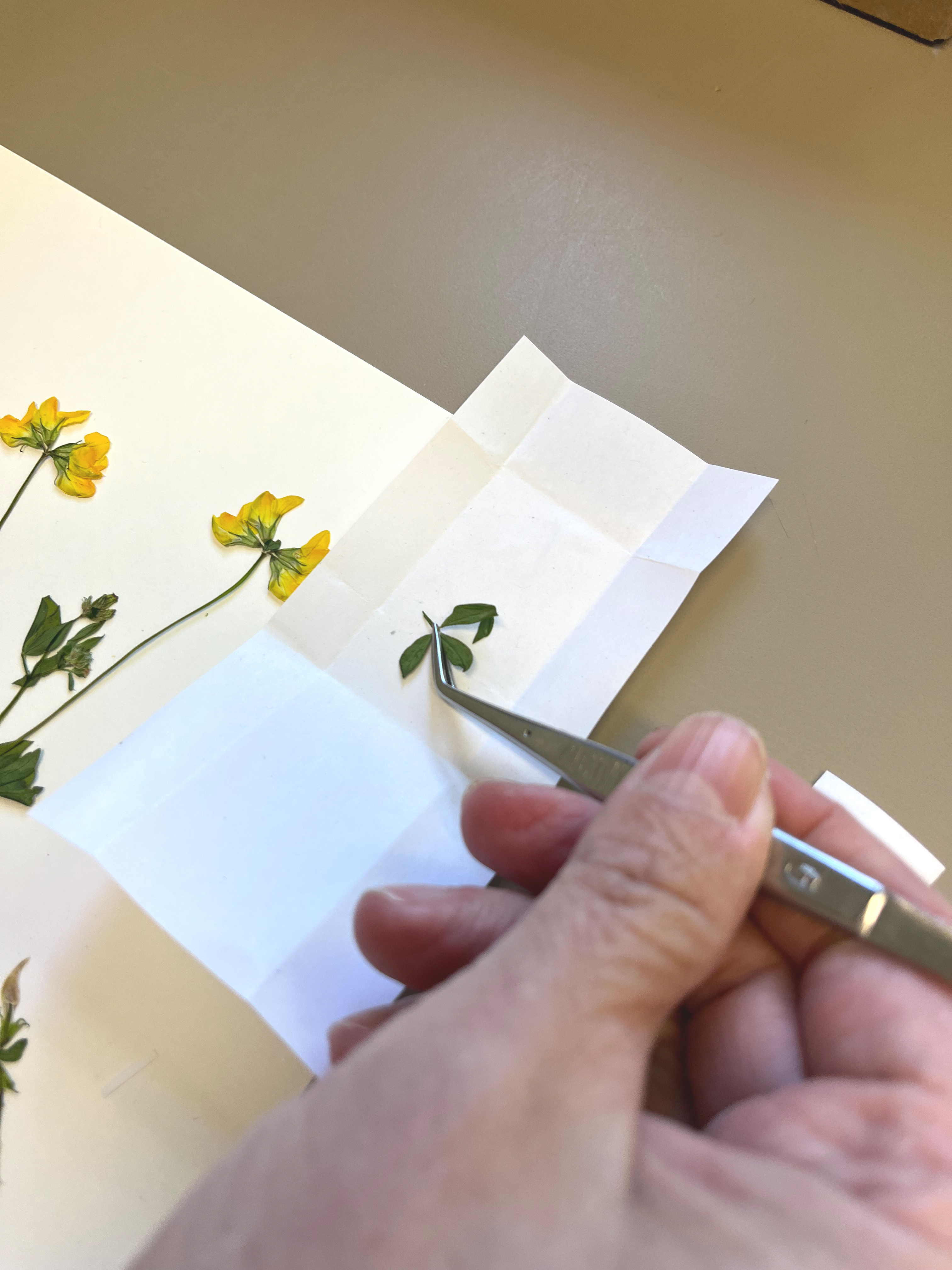
(Copyright: C. Dalitz / SMNS)
Herbarbeleg einer Blume mit Etikett und einem kleinen gefalteten Umschlag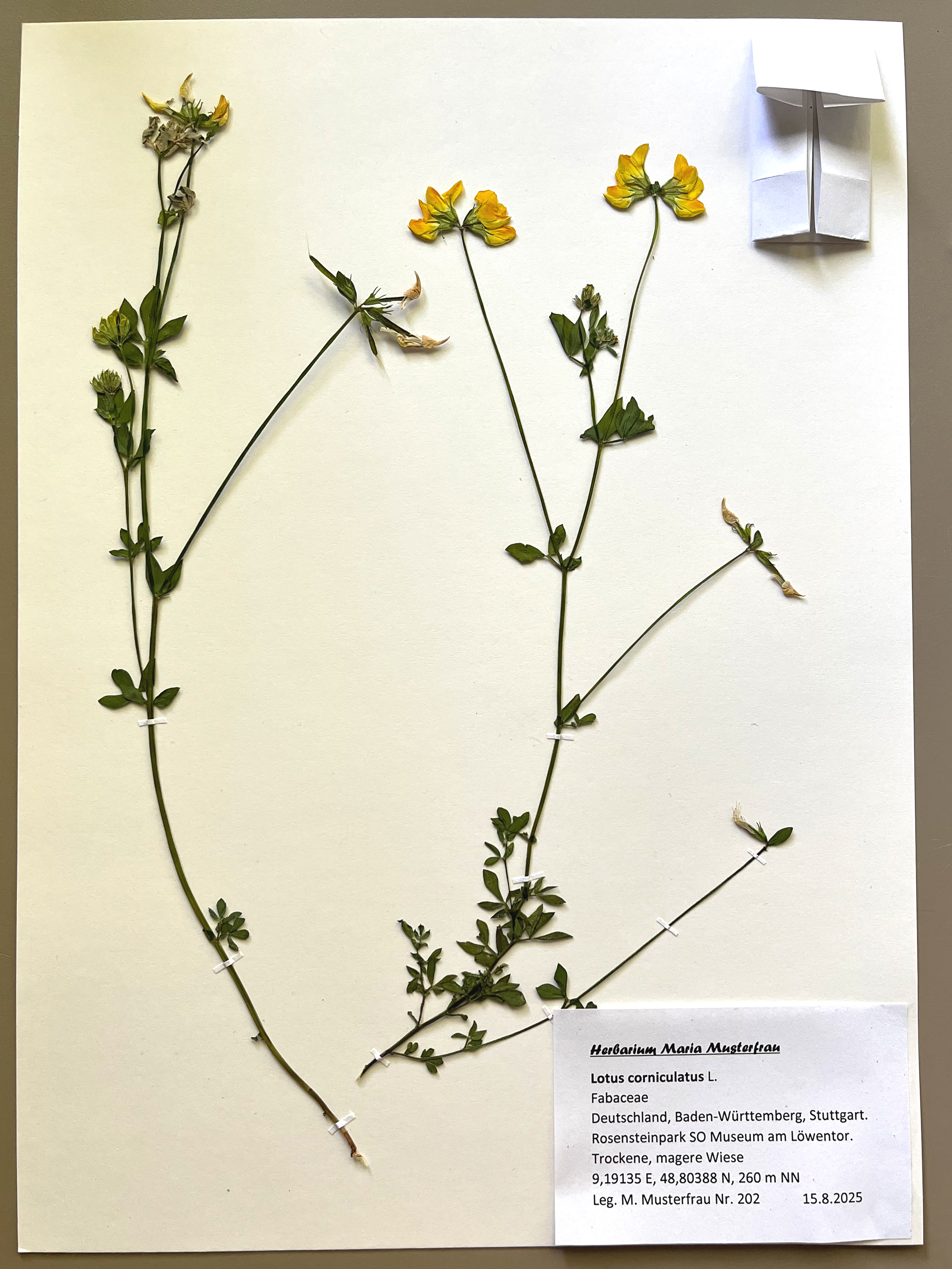
Done! (Copyright: C. Dalitz / SMNS)
Storage
The herbarium sheet is placed inside a folded sheet of paper for protection, so that any parts which may have come loose despite all care are not lost and can be assigned to the correct specimen.
The completed sheets should be stored dry and away from light in a tightly closing cabinet, organised alphabetically by family, genus and species
Beetles and their larvae are always a potential threat to any herbarium. They are particularly fond of eating delicate flowers or seeds rich in starch and fat, often leaving behind nothing but crumbs. A specimen that has been infested soon becomes impossible to identify.
For this reason, you should inspect your collection regularly. If you discover beetles, larvae or traces of feeding, the herbarium sheets must be sealed in plastic bags and frozen for a few days in order to kill the insects.
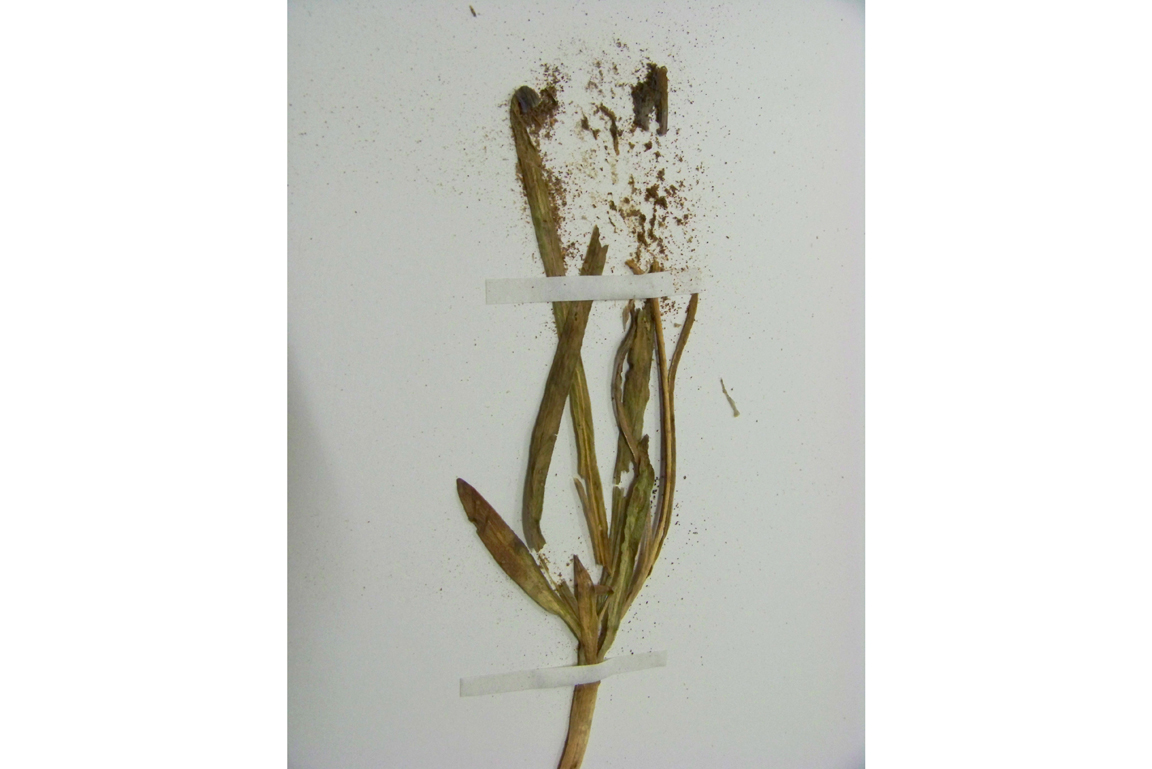
Caution! Dine-and-dash and vandalism. (Copyright: A. Rosenbauer / SMNS)
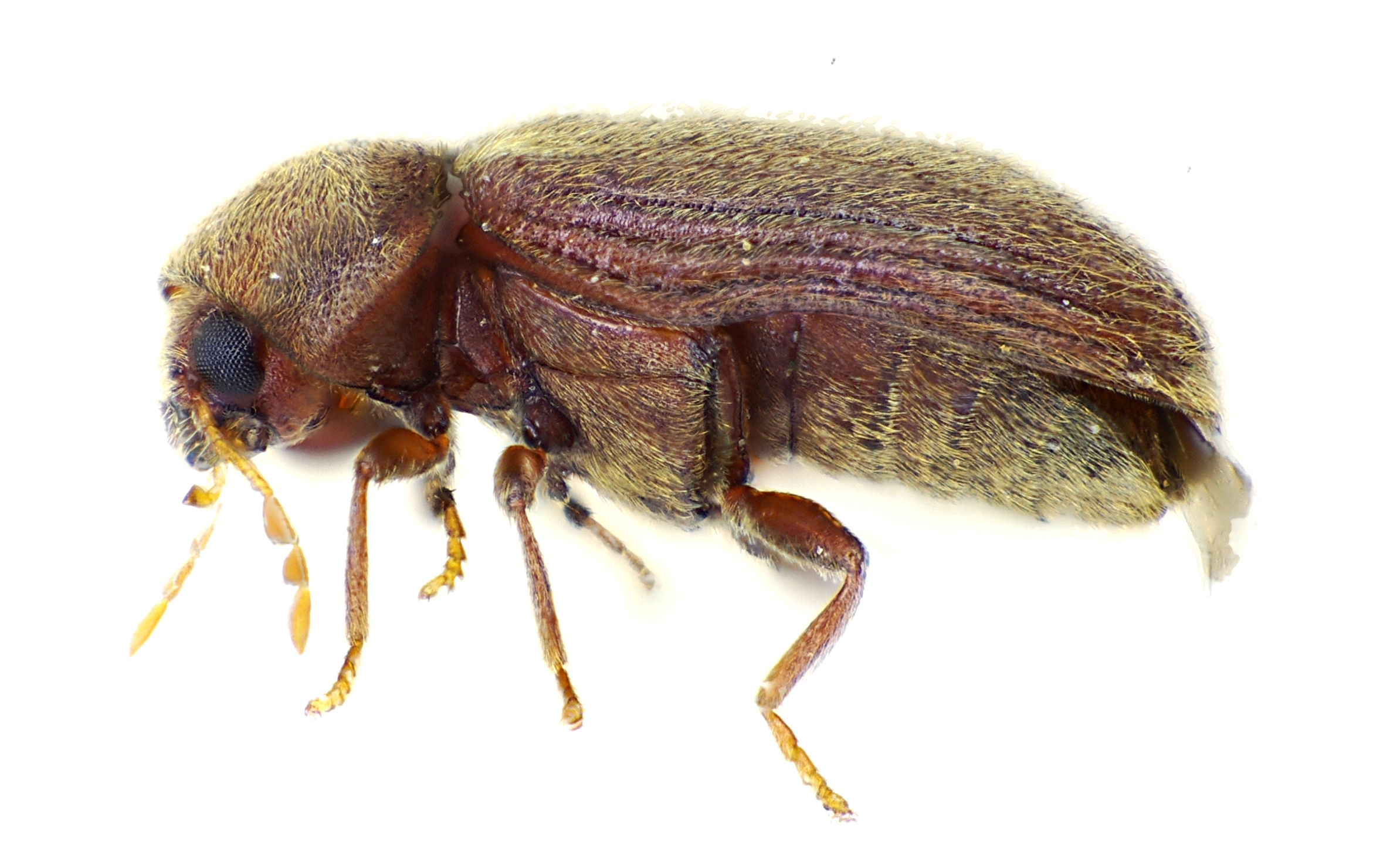
Herbaria are particularly vulnerable to the drugstore beetle and its larvae, which are only a few millimetres long and especially fond of feeding on herbarium specimens. (Copyright: Siga, CC BY-SA 3.0, https://commons.wikimedia.org/w/index.php?curid=6155513)
Just a pile of hay?
And why do we preserve hundreds of thousands of old and new herbarium specimens in the museum?
Herbaria are an essential and indispensable basis for the naming and differentiation of plant species. Every description of a new species is based on a herbarium specimen, the so-called type specimen, to which the name is linked. The type specimen is, in a sense, the archival “original metre” for a particular species. Around 2,400 of these type specimens are stored in the Stuttgart Herbarium.
However, most herbarium specimens are not types, but further collections of already known plant species. A herbarium also serves as a reference collection, allowing difficult-to-identify species to be compared with reliably determined specimens. Scientists from here and around the world work with herbarium specimens from Stuttgart to research the distribution, variability, species delimitation, and relationships of plant species. Herbarium specimens are used, for example, to create distribution maps, or to demonstrate that a particular species was once present in an area where it no longer occurs today. Such verifiable data are an indispensable basis for compiling Red Lists, which are used to assess the threat status of animal and plant species. Newly occurring plant species are also documented by means of herbarium specimens, enabling the spread of potentially invasive neophytes to be tracked.
Herbarbeleg einer Orchidee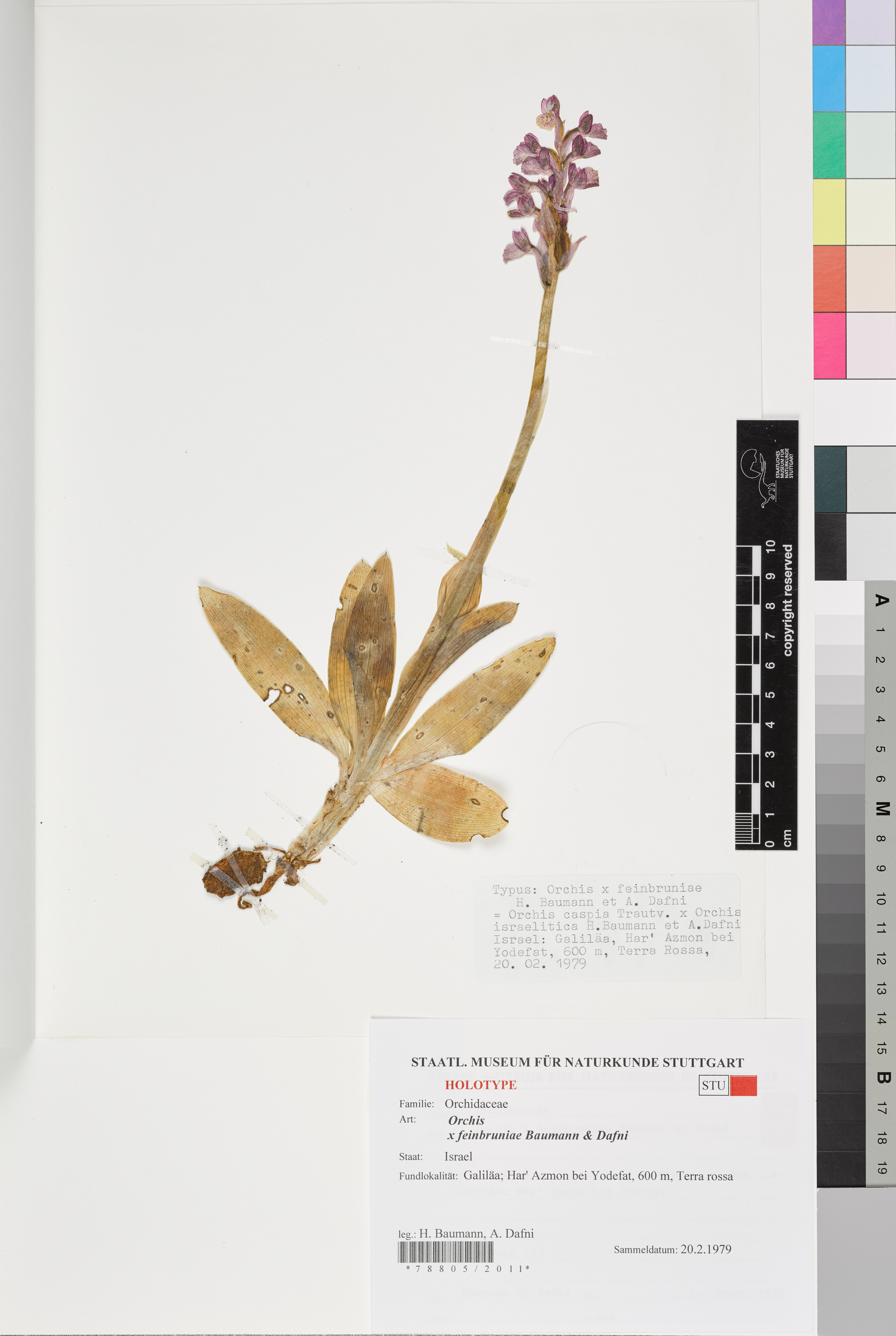
Type specimen of an orchid species. (Copyright: C. Dalitz / SMNS)
Is that all there is?
No, of course not!
The herbarium of the Stuttgart Museum of Natural History also includes extensive collections of mosses, fungi, lichens and algae.
But that is a story for another time …
Comments (0)
No Comments